

Ike & Tina Turner Workin’ Together Review: Soul, Grit, and the Sound of a Band on Fire
A record powered by grit, groove, and a moment that couldn’t last.
Wine Score: ★★★★☆ (4/5)
Album Score: ★★★★☆ (4/5)
Scores reflect my personal experience — less about perfection, more about vibe.
Workin’ Together doesn’t ease you in.
From the opening track, Ike & Tina sound like they’re already in motion, locked into a groove, pushing forward, no patience for warm-ups. This is music built on momentum and pressure, where the rhythm never quite relaxes and the energy always feels earned.
It’s an album driven by force more than finesse, by movement rather than reflection. Some moments glide. Others grind. All of it feels immediate. That tension, between control and release is what gives Workin’ Together its heat. And it’s why this record still demands attention when the needle drops.
What’s always pulled me back to Workin’ Together is how wide its reach is. The album balances originals written by Ike with covers pulled from across the musical landscape of the moment, giving the record a restless, almost searching quality. It doesn’t sit still for long.
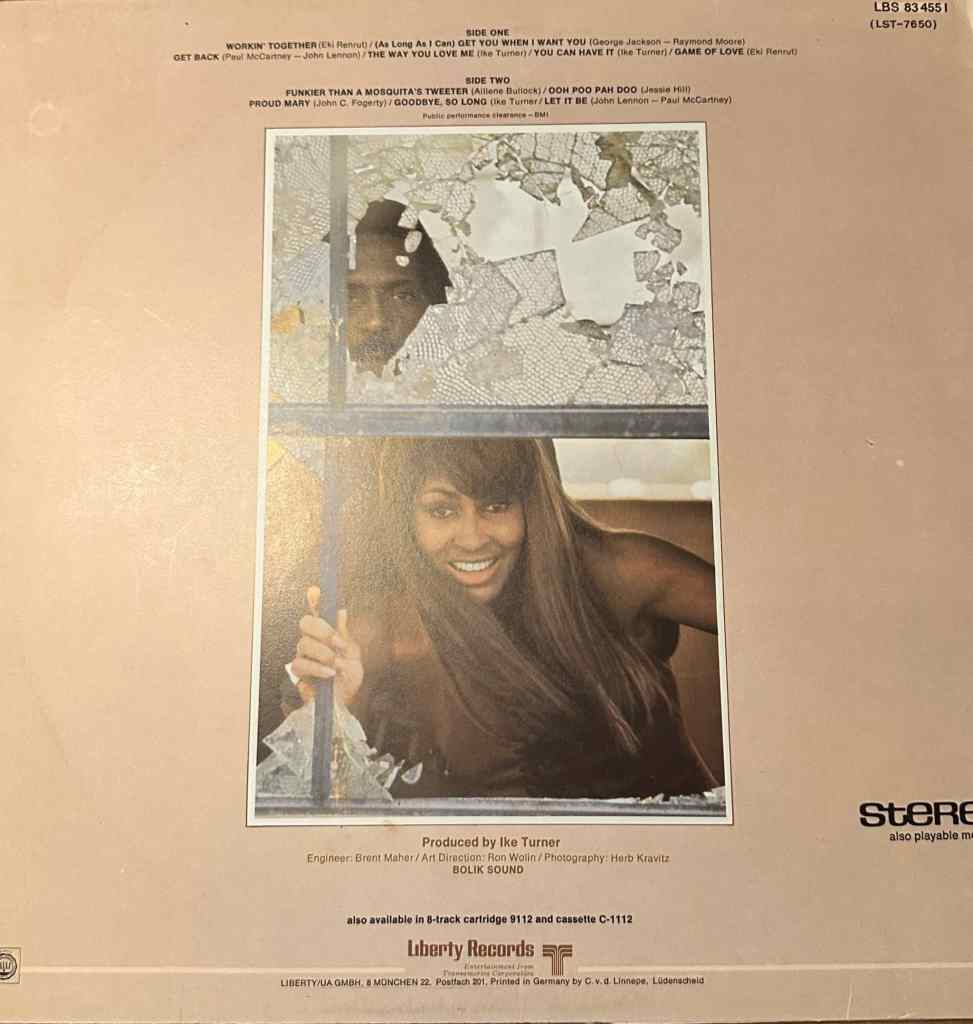
Alongside Ike’s own material is one standout written by Tina’s sister, Funkier Than a Mosquita’s Tweeter, a track that leans fully into grit and groove. The covers tell their own story: Get Back and Let It Be from The Beatles, Ooh Poo Pah Doo by Jessie Hill, and of course Proud Mary from Creedence Clearwater Revival, which deserves its own moment a little later on.
Together, these choices make Workin’ Together feel less like a single statement and more like a snapshot of a band absorbing everything around them, then pushing it out louder.

Proud Mary, Reworking a Rock Standard into Pure Soul
There are covers, and then there are transformations. Ike & Tina Turner’s take on Proud Mary belongs firmly in the latter category. Where the original holds its ground with restraint, this version stretches the song into something elastic, slow-burning at first, then explosive when the switch finally flips.
Tina frames it plainly, easy at the start, rough at the finish. That contrast isn’t just a stage cue; it’s the blueprint. The song takes its time setting the mood before snapping into focus with force and intent. When the groove locks in, it hits with purpose, the rhythm section driving hard while the vocals push right up to the edge.
It’s also the moment where Workin’ Together shows its hand. This isn’t about polishing someone else’s song. It’s about ownership. By the time the needle lifts, “Proud Mary” no longer feels borrowed, it feels claimed, reshaped into something louder, rougher, and unmistakably theirs.
Finding Workin’ Together on vinyl today is refreshingly straightforward. Original early-’70s pressings still turn up with some regularity, and because this album sold well, prices stay reasonable compared to flashier titles in the catalog. Expect clean, playable originals to land somewhere in the $20–$35 range, with price swings mostly driven by condition, quiet vinyl and intact sleeves matter more here than label variations.
Reissues are even easier. Later pressings and modern represses typically fall closer to the $18–$25 range, making this an accessible pickup for anyone who wants the experience without chasing provenance. Sonically, most decent reissues hold up well; this is an album built on feel and energy more than audiophile nuance.
In other words, this isn’t a record you have to hunt for or handle with white gloves. It’s meant to be played, turned up, and lived with. Whether you land an original or a clean repress, Workin’ Together delivers the same payoff when the groove finally locks in.


The Groove and the Glass
Workin’ Together is a record built on momentum, nothing flashy, nothing overthought, just parts locking in and pushing forward. That’s why an old-vine California Zinfandel fits so naturally alongside it. This is a wine that shows up ready to work, with weight and warmth but no interest in showing off.
Old-vine Zinfandel tends to bring deeper fruit and a little natural spice, and that plays well with the album’s mix of grit and groove. The first sip feels friendly and familiar, then the edges start to show as it opens up, much like the record itself as it moves from side to side.
The cost of entry stays reasonable. You’re looking at a bottle that lands right around the mid-teens, maybe creeping a bit higher depending on where you buy it. That makes it an easy reach for a listening night without turning the wine into the main event.
How to handle the pour:
• Room temperature is best, no chilling needed
• Pour a glass and give it 15–20 minutes to breathe
• No decanter required; just let it open up while the needle settles in
This pairing works because neither element tries to steal the spotlight. The wine has structure and power, the album brings tension and release, and together they settle into a rhythm that feels natural, both doing their part, workin’ together, start to finish.
Charles’ Pour Notes
Wine: Klinker Brick Old-Vine California Zinfandel
Profile: Dark berry fruit up front, a touch of pepper and spice in the middle, and a warm finish that lingers without getting heavy. Nothing fussy here, just depth, warmth, and a bit of edge as the glass opens up.
Pairing Mood: Best poured once the day is done and the volume is up. This pairing works when you’re not rushing, lights low, needle down, and letting the album unfold side by side with the wine. Easy at first, rougher as it goes, and better the longer you stay with it.

A Final Note
Workin’ Together works best when you don’t rush it. Let the sides play through, let the rough edges show, and don’t worry about smoothing anything out. This is a record built on motion and feel, not perfection.
With a glass of old-vine Zinfandel nearby, the experience settles into something easy and familiar. The music carries the weight, the wine fills in the spaces, and neither asks much more than your time. When the needle lifts, there’s no grand takeaway—just the sense that both were better together than on their own.
That’s usually a good sign you picked the right pairing.
If you’re in the mood to keep the rhythm moving, our reflection on Michael Jackson’s Off the Wall explores what happens when motion turns into pure release.