

The Beatles Sgt. Pepper’s Lonely Hearts Club Band Review (Vinyl Listening Guide)
A vinyl listening reflection on The Beatles’ Sgt. Pepper’s Lonely Hearts Club Band, the psychedelic studio landmark that reshaped what an album could be.
Wine Score: ★★★★☆ (4/5)
Album Score: ★★★★☆ (4/5)
Scores reflect my personal experience — less about perfection, more about vibe.
Some records don’t just pass through your life, they help shape how you hear music in the first place.
For me, Sgt. Pepper’s Lonely Hearts Club Band by The Beatles is one of those records.
Growing up in a city where cultures, neighborhoods, and experiences blended together, I was lucky to be exposed to a lot of different influences early on. One of my closest childhood friends lived just a few blocks away, and his family welcomed me into their home the way good families do, food on the table, conversation in the kitchen, and music always somewhere in the background.
His mom especially loved music. And above all, she loved The Beatles.
Almost every day after school I would stop by their house, and more often than not the moment she walked through the door a record would start spinning. That home became my introduction to a whole different musical world, one that sat right alongside the soul, funk, and R&B that already filled my own house growing up.
That’s where albums like Sgt. Pepper first entered my orbit.
Long before I understood studio production, orchestration, or the idea that an album could function as a complete listening experience, this record was already teaching me those lessons. The instruments felt bigger. The arrangements were unpredictable. Songs didn’t always move where you expected them to go. Brass bands could open a rock album. Orchestras could explode into chaos and somehow resolve into a single lingering piano chord.

If you’ve spent time on Needle & Vine, you’ve probably seen me talk about artists like Stevie Wonder or Isaac Hayes when describing records that helped define my musical compass. Sgt. Pepper belongs in that same personal lineage. Different genre, different energy, but the same feeling that an album could be immersive, inventive, and worth experiencing from beginning to end.
For anyone building a thoughtful vinyl collection, this is one of those records that deserves a spot on the shelf, not simply because of its reputation, but because once you spend time with it, you begin to understand why it has remained part of the conversation for nearly sixty years.
The Listening Ritual
Before the needle drops, set the tone. Whether you’re revisiting this album or hearing it for the first time, here’s how to experience it fully.
🎧 Start the Record
Stream the album on your preferred platform and settle into the mood before the first side begins.
🍷 Pour the Pairing
Bring the full experience together with a bottle that complements the character of the record.
Availability may vary by location.
🎵 Own the Record
For readers who want the full analog experience, here’s where to track down the album on vinyl.

The Needle Drop
There’s something theatrical about the way Sgt. Pepper’s Lonely Hearts Club Band begins.
Before the music even arrives, you hear the murmur of a crowd, a room settling in, anticipation building and then the brass band suddenly bursts forward as The Beatles introduce their fictional alter-ego ensemble. It doesn’t feel like the start of a typical rock record. It feels like the curtain rising.
The title track is confident, colorful, and deliberately staged, setting the tone for everything that follows. Horns punch through the mix, guitars weave underneath, and the band leans fully into the illusion that this is a live performance from the “Sgt. Pepper” band itself.
Without pause, the record slides directly into “With a Little Help from My Friends,” where Ringo Starr steps forward with one of the most endearing vocal moments in the band’s catalog. On vinyl, that transition is seamless, one of those small sequencing choices that reminds you this album was designed to be experienced as a continuous journey rather than a loose set of singles.
From the opening minutes alone, the ambition is clear. The arrangements are bigger, the sonic palette wider, and the structure far more playful than most rock albums of its era. As the record unfolds, drifting through dreamlike psychedelia, carnival atmospheres, and moments of quiet reflection it keeps building toward something larger. Because while the opening invites you into the performance, the album ultimately saves its most powerful statement for the closing act, a track that brings the entire experience to a breathtaking conclusion.
Inside the Studio: Where Sgt. Pepper Changed the Rules
When Sgt. Pepper’s Lonely Hearts Club Band was released in 1967, it sounded unlike almost anything else on the radio. Part of that was creative ambition, but a large part of it came from a simple decision by The Beatles: they stopped trying to reproduce their music on stage and focused entirely on what could happen inside the studio.
Working with producer George Martin at Abbey Road Studios, the band treated the recording process itself as an instrument. Tape loops, layered orchestration, unusual microphone placement, and experimental editing techniques all became part of the palette.
That freedom shows up throughout the album. “Lucy in the Sky with Diamonds” drifts between dreamlike verses and punchy choruses. “Being for the Benefit of Mr. Kite!” feels like a carnival assembled from fragments of tape and calliope sounds. Even quieter moments like “She’s Leaving Home” lean on orchestration and storytelling rather than traditional rock arrangements.
The result is an album that feels less like a set of songs and more like a carefully staged world — one that shifts constantly between color, mood, and texture.
And while those experiments unfold across the record, they ultimately lead to a closing moment that brings everything together in a way few albums had attempted before.
What to Expect to Pay
If you’re shopping for Sgt. Pepper’s Lonely Hearts Club Band on vinyl, prices can vary quite a bit depending on the pressing and condition.
Expect roughly:
- $25–$35 – Modern reissues (common and easy to find)
- $60–$120 – Early U.S. pressings in solid VG+ condition
- $150+ – Clean originals or desirable early stampers
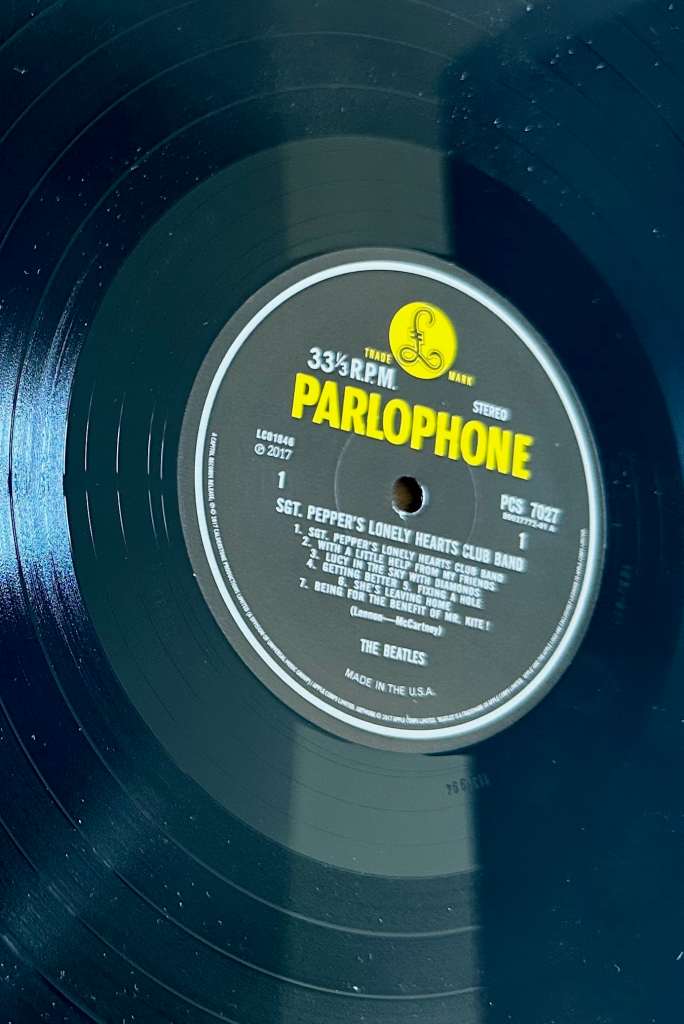
That pricing spread is exactly why it pays to slow down and look closely before pulling the trigger. I learned that the hard way with my own copy. I came across what appeared to be a pristine record, the cover looked fantastic and the vinyl itself showed very little wear. At first glance it felt like I might have stumbled onto something special. I paid a pretty healthy price thinking I had found an older pressing worth getting excited about.
After digging into the details later, it turned out the record was actually a more recent reprint. Remember what I said in my article about looking for cheap vinyl, you’re going to make mistakes even after years of practice.
Now that doesn’t necessarily mean the record sounds bad. Many modern reissues play beautifully and are perfectly fine for someone who simply wants to enjoy the music. But when you’re dealing with an album this iconic, collectors naturally pay closer attention to pressing history.
You’ve heard me talk about matrix numbers in other articles, and this is exactly why they matter. When you think you’ve struck gold, that’s the moment to do a little due diligence. Check the runout etchings in the deadwax, compare catalog numbers, and verify the pressing details against listings on Discogs before assuming you’ve found an early original.
With a record as famous as this one, there are many versions circulating in the wild. Some are priced correctly. Some are not. When you’re buying a piece of musical history like this, a few extra minutes of research can save you from paying original-pressing prices for a modern reissue. If you’re still learning the ropes of crate digging, I share a few lessons from my own mistakes in my guide on finding cheap vinyl records.


The Groove and the Glass
For a record as colorful and layered as Sgt. Pepper’s Lonely Hearts Club Band, the wine pairing should bring a little personality of its own.
This is where an Gewurztraminer fits beautifully.
Gewurztraminer is one of the most aromatic wines you’ll encounter. Bright tropical fruit, subtle floral aromas, and a hint of spice give it an almost exotic character, the kind of wine that immediately grabs your attention. In a way, it behaves much like the album itself.
From the theatrical brass of the opening track to the surreal dreamscape of “Lucy in the Sky with Diamonds,” Sgt. Pepper constantly shifts colors and textures. Gewurztraminer mirrors that experience in the glass, offering bursts of flavor that feel just as expressive as the music coming through the speakers.
It’s not a quiet pairing. And that’s exactly the point.
Pouring Directions
- Chill it: Cold, but not ice cold. Around 45–50°F works well.
- Use a standard white wine glass: Nothing oversized.
- Pour a modest glass: Enough to enjoy without overthinking it.
- Skip the decanter: Gewurztraminer is meant to be opened and enjoyed.
- Open and enjoy: Wines like this pair best with a relaxed listening session.
Together they create a listening session that feels playful, immersive, and just a little unexpected, which might be the most fitting tribute to what The Beatles were trying to accomplish with this record in the first place.
Charles’ Pour Notes
Wine: Arthur Metz Gewurztraminer
Profile: Aromatic and expressive. Tropical fruit, soft floral notes, and a gentle touch of spice. Medium-bodied with a round texture and a lingering, fragrant finish. It’s the kind of wine that announces itself the moment it hits the glass.
Pairing Mood: Late evening. Lights dim. The record sleeve sitting open nearby. This is a listening session record, the kind where the needle drops and the room settles in. Not background music, but something you give your attention to. A glass poured, the album unfolding, and the sense that you’re stepping into a performance rather than just playing a record.

A Final Note
Every great album leaves you with a moment that lingers after the music stops. For Sgt. Pepper’s Lonely Hearts Club Band, that moment arrives with the closing track, “A Day in the Life.”
If you’re listening to this record for the first time or revisiting it after years away, this is the point where it pays to slow down and really pay attention.
The song moves through a series of emotional shifts that feel almost cinematic. John Lennon opens with reflective, almost dreamlike verses before the arrangement begins to expand outward. The orchestral sections surge upward in controlled chaos, building tension in a way that still feels startling decades later.
Then the music resolves itself in one of the most memorable endings ever captured on tape.
A single massive piano chord struck together by The Beatles and producer George Martin rings out and slowly fades into silence. On vinyl, that moment feels especially powerful. The resonance hangs in the room, the sound stretching out until it finally dissolves into the quiet of the groove.
It’s a bold ending, and a fitting one.
Because from the theatrical opening moments to that final lingering chord, Sgt. Pepper never stops pushing at the edges of what an album could be. It invites you into a performance, lets the colors and ideas unfold, and then closes the curtain with a moment that refuses to be ignored.
Not every record needs to change music history.
But every once in a while, one actually does.