

Isaac Hayes – Hot Buttered Soul Review (1969 Enterprise Vinyl)
Expanded soul. Original 1969 Enterprise vinyl. A record built for slow listening.
Wine Score: ★★★★☆ (4/5)
Album Score: ★★★★☆ (4/5)
Scores reflect my personal experience — less about perfection, more about vibe.
An Album That Demands Space
Isaac Hayes’ Hot Buttered Soul (1969) is less a collection of songs and more a shift in posture. It asks you to sit down. To slow down. To give it the room it requires.
Released in the United States on the Enterprise imprint (ENS-1001), this was not soul music built for radio urgency. It was built for immersion. Four extended tracks stretch across nearly forty-five minutes, unfolding deliberately, strings widening, rhythm sections simmering, Hayes’ voice steady and unhurried at the center.
On an original 1969 Enterprise pressing, the album feels physical in a way streaming rarely captures. The low end carries weight. The orchestration breathes. Silence between passages becomes part of the architecture.
This is not background music.
It’s an evening commitment.
The Listening Ritual
Before the needle drops, set the tone. Whether you’re revisiting this album or hearing it for the first time, here’s how to experience it fully.
🎧 Start the Record
Stream the album on your preferred platform and settle into the mood before the first side begins.
🍷 Pour the Pairing
Bring the full experience together with a bottle that complements the character of the record.
Availability may vary by location.
🎵 Own the Record
For readers who want the full analog experience, here’s where to track down the album on vinyl.

When Soul Slowed Down
Hot Buttered Soul announces itself immediately with “Walk On By.”
Not the three-minute radio version made famous by Dionne Warwick, but a twelve-minute reinvention. From the opening hi-hat shimmer, you know this won’t rush.
Hayes doesn’t chase the melody.
He circles it.
The strings stretch wide before his voice even arrives. The rhythm section settles into a patient, almost hypnotic pulse. When he finally enters, it isn’t with urgency, t’s with authority. Controlled. Measured. Already aware of the outcome.
And if you’ve ever watched a Blaxploitation-era film, especially something like Shaft these textures feel instantly recognizable.
The orchestral swells. The restrained funk undercurrent. The cool, unbothered confidence in the vocal delivery. That cinematic language, the sound of tension building without shouting lives here.
Before Hayes would score Shaft and define that era sonically, Hot Buttered Soul was already sketching the blueprint. “Walk On By” unfolds like a scene. The groove doesn’t push forward; it waits. The strings don’t punctuate; they expand.
Even “Hyperbolicsyllabicsesquedalymistic”, rhythmically sharper and more groove-driven, never abandons composure. It locks into its pocket and lets atmosphere thicken around it.
These performances aren’t structured for radio.
They’re structured like film, tension, space, release.
And when you hear it that way, the album’s length stops feeling indulgent.
It feels deliberate.
The 1969 Enterprise Pressing: Weight, Space, and Intention
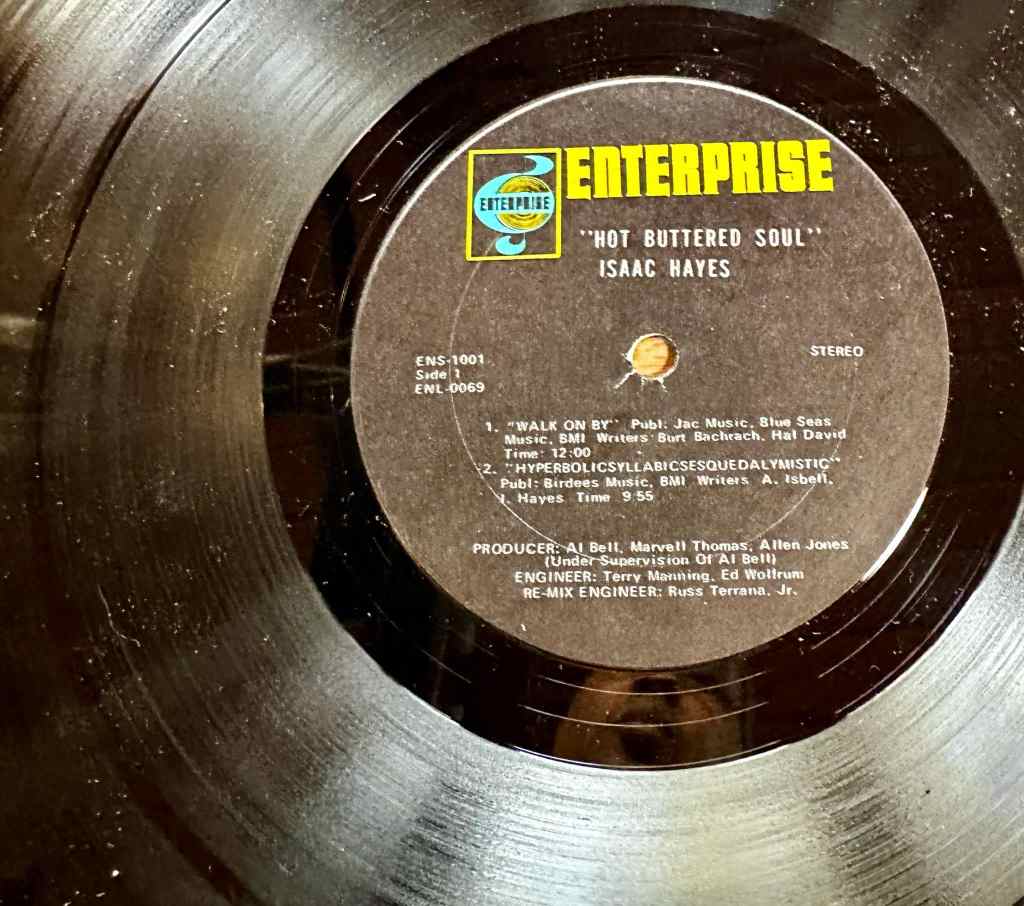
My copy is the original 1969 U.S. Enterprise issue (ENS-1001), with matrix ENL-0070-2 and ENL-0069-3, and a stamped “T” in the deadwax indicating Columbia’s Terre Haute pressing plant.
The first time I dropped the needle on this Terre Haute cut, what stood out wasn’t volume, it was space. The strings in “Walk On By” didn’t crowd the room; they stretched across it. The bass felt steady and grounded, more Memphis than Hollywood. Hayes’ voice sat calmly at center, never pushing, never pleading.
Those matrix details matter only because of what they allow you to hear.
The “-2” and “-3” lacquer suffixes point to early production runs within that original 1969 window, and this pressing carries that first-year warmth. The low end has weight without muddiness. The orchestration widens instead of compressing inward. Long passages are given room to unfold.
And this record needs room to breathe.
What to Expect to Pay
An original 1969 Enterprise pressing in clean, solid VG+ condition typically lands in the $25–$60 range, depending on jacket condition and surface wear. True near-mint copies climb higher, especially with a sharp gatefold and minimal spindle wear.
The good news: this isn’t an impossible record to find. It sold well. With patience, crate digging can still reward you.
Modern reissues are widely available and far easier to source. Expect to pay $20–$35 for a new reprint from major retailers. Many of these newer cuts are clean and quiet, ideal for casual listening though they may not carry the same low-end bloom or slightly relaxed staging of an early Enterprise pressing.
If your goal is immersion and atmosphere, the original cut has a certain gravity.
If your goal is accessibility, the reissue delivers the music without the hunt.
Both will move the air in the room.
But only one carries the quiet thrill of being first-year vinyl.


The Groove and the Glass
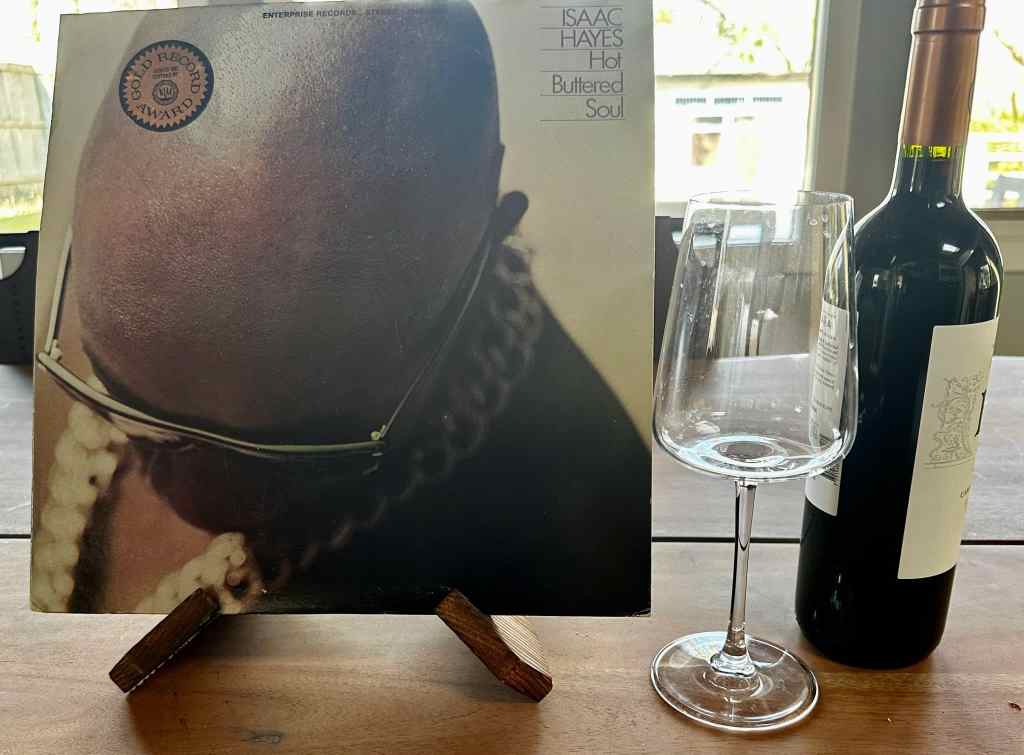
For this session, I reached for a Rhône Valley Syrah from Halos de Jupiter.
Hot Buttered Soul isn’t a bright or playful record. It moves slowly. It builds gradually. A Syrah like this does the same. Dark fruit, a little pepper, a touch of earth, nothing flashy, nothing sharp.
As “Walk On By” stretches past the ten-minute mark, the wine settles in. It doesn’t demand attention. It just holds the room the way Hayes does, steady and composed.
This isn’t a pairing for a quick spin.
It’s for an evening when you’re willing to sit with both the record and the glass a little longer than usual.
Let the album unfold. Let the wine open.
Neither one is in a hurry.
Keep it simple.
- Let it breathe: Open the bottle 15–20 minutes before you press play.
- Use a standard red wine glass: Nothing oversized or theatrical.
- Room temp, not warm: Around 60–65°F is perfect.
- Pour a modest glass: Enough to last a full side.
- Skip the ceremony: No decanter needed.
This isn’t a bottle to analyze. It’s a bottle to sit with.
Pour it. Lower the lights. Drop the needle.
Let both unfold at their own pace.
Charles’ Pour Notes
Wine: Halos de Jupiter Syrah
Profile: Dark berry, cracked pepper, subtle earth, and soft smoke. Medium-plus body with steady structure and restrained tannins. No flash, just depth and balance.
Pairing Mood: Late evening. Low light. No interruptions. The kind of night where one side of vinyl becomes the whole plan.
A Final Note
Some albums ask for attention.
Hot Buttered Soul asks for patience.
Rooted in Memphis but thinking beyond radio, Isaac Hayes built a record that doesn’t chase momentum. It holds posture. It lets tension develop. It trusts the room to stay with it. On an original 1969 Enterprise pressing, that patience becomes physical, stylus in groove, bass moving air, strings widening the space between the speakers. It isn’t about volume. It isn’t about spectacle.
It’s about control.
And that’s what makes this album endure. Not because it’s loud. Not because it’s flashy. But because it understands that slowing down, truly slowing down can be its own form of power.
If Hot Buttered Soul rewards your patience, our session with Stevie Wonder’s Talking Book is worth the same quiet attention.
Pour something structured. Lower the lights. Let the first track unfold.
Then stay.