

HumminGuru EZ Record Washer Review: Is This the Best $100 Upgrade for Vinyl Collectors?
HumminGuru EZ Record Washer Review: Is It Worth Buying?
If you’ve been cleaning records with nothing more than a carbon fiber brush, the HumminGuru EZ Record Washer is one of the more interesting products to arrive in the vinyl hobby. Sitting around the $100 mark, it promises a deeper clean without jumping into the $400–$800 world of ultrasonic machines.
But where exactly does it fit? After looking at its design and comparing it with more traditional manual systems like the Spin-Clean, here’s where I think it makes the most sense.
(Affiliate links are included below, but like all recommendations here, they’re about usefulness, not hype.)
It’s Not an Ultrasonic Cleaner and That’s Okay
This is probably the biggest misconception.
The EZ doesn’t create cavitation like the larger HumminGuru ultrasonic cleaner. There are no transducers and no automatic drying cycle.
Instead it combines:
- a water bath
- rotating record
- dual goat-hair brushes
- cleaning fluid
That already puts it several steps beyond simply wiping a record with a cleaning brush. Think of it as moving from “surface dust removal” to actual groove cleaning.
For someone building a collection, that’s a meaningful upgrade without spending several hundred dollars more.
Compared with the Spin-Clean
Spin-Clean has been around forever.
HumminGuru looked at that concept and modernized it.
- Advantages over Spin-Clean:
- better label clamp keeps labels dry
- integrated draining system
- cleaner overall presentation
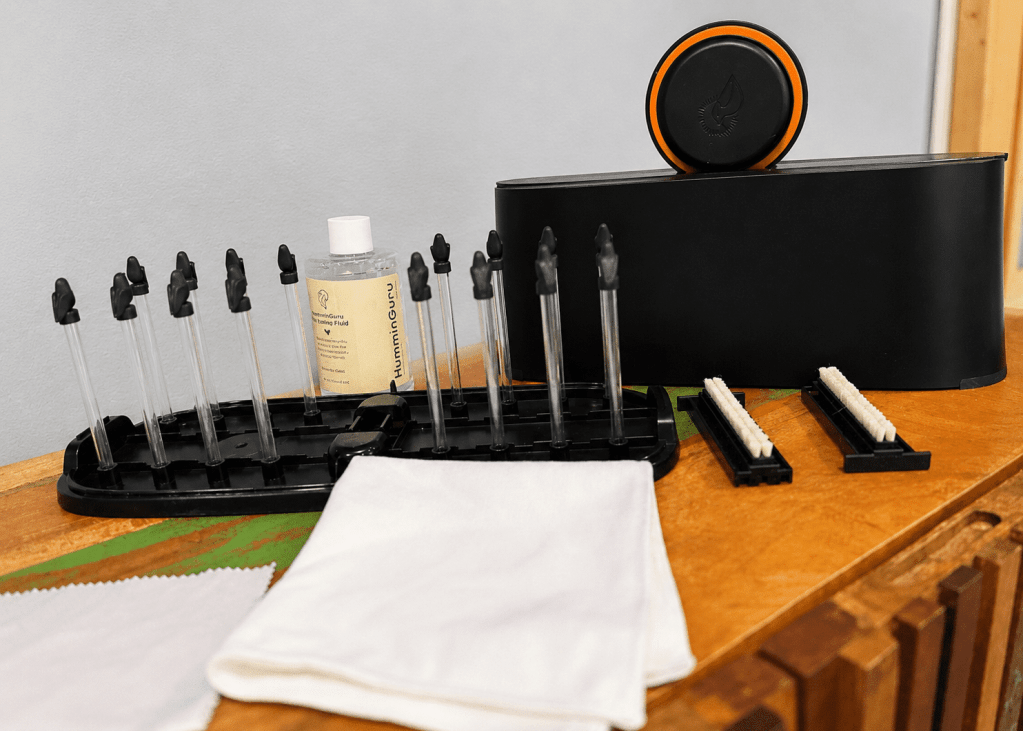
- included drying rack stores underneath
- compact footprint
- easier storage
Cleaning performance is likely to be very similar since both rely on manual rotation through cleaning brushes.
The difference is really convenience and user experience.
Someone buying their first record washer today would probably find the HumminGuru easier to live with.
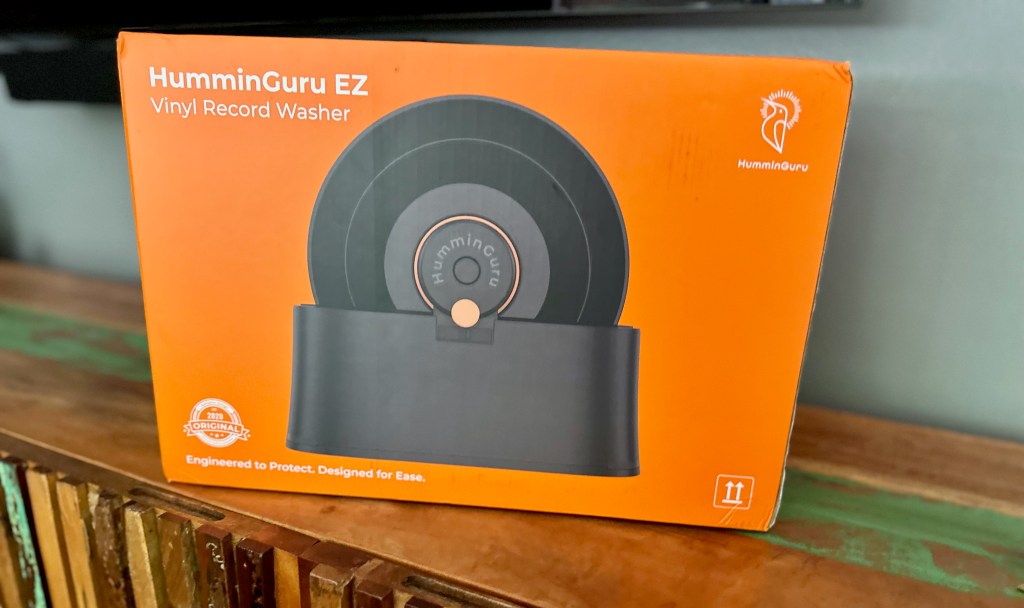
Initial Setup
Fortunately, there isn’t much.
Assembly mainly consists of:
- installing the handle
- inserting the brushes
- preparing the drying rack
- filling the basin
Five minutes and you’re cleaning records.
No complicated calibration. No pumps. No vacuum arms.
No maintenance beyond rinsing everything afterward.
Distilled Water Isn’t Optional
This is one area where it pays not to cut corners.
Tap water contains dissolved minerals.
As the water dries, those minerals stay behind inside the record grooves.
That can leave residue that attracts more dirt or in hard water areas, create deposits that are difficult to remove later. Distilled water avoids that problem because virtually all of those minerals have already been removed.
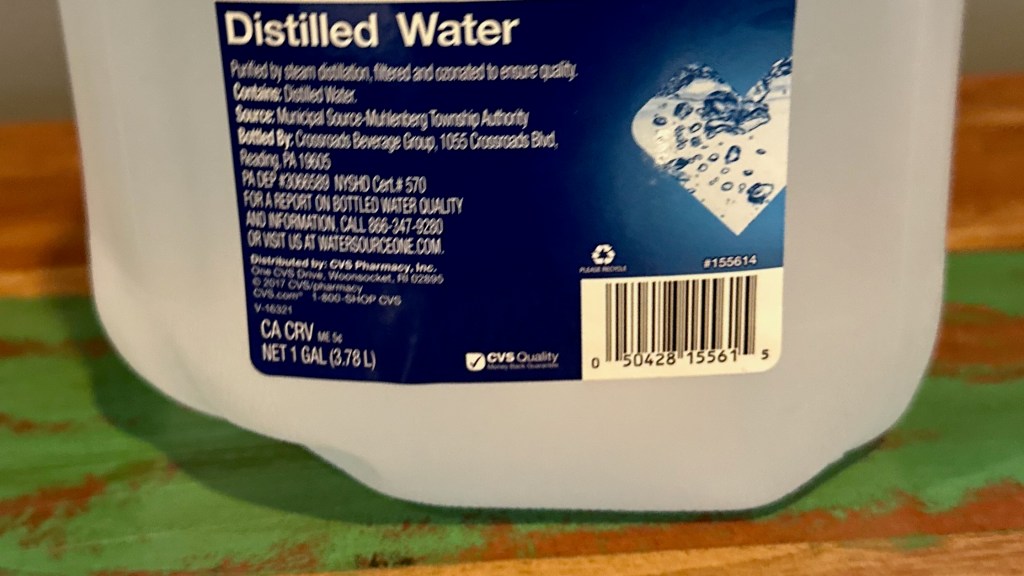
Considering a gallon costs only a couple dollars and lasts many cleaning sessions, it’s one of the cheapest upgrades you can make.
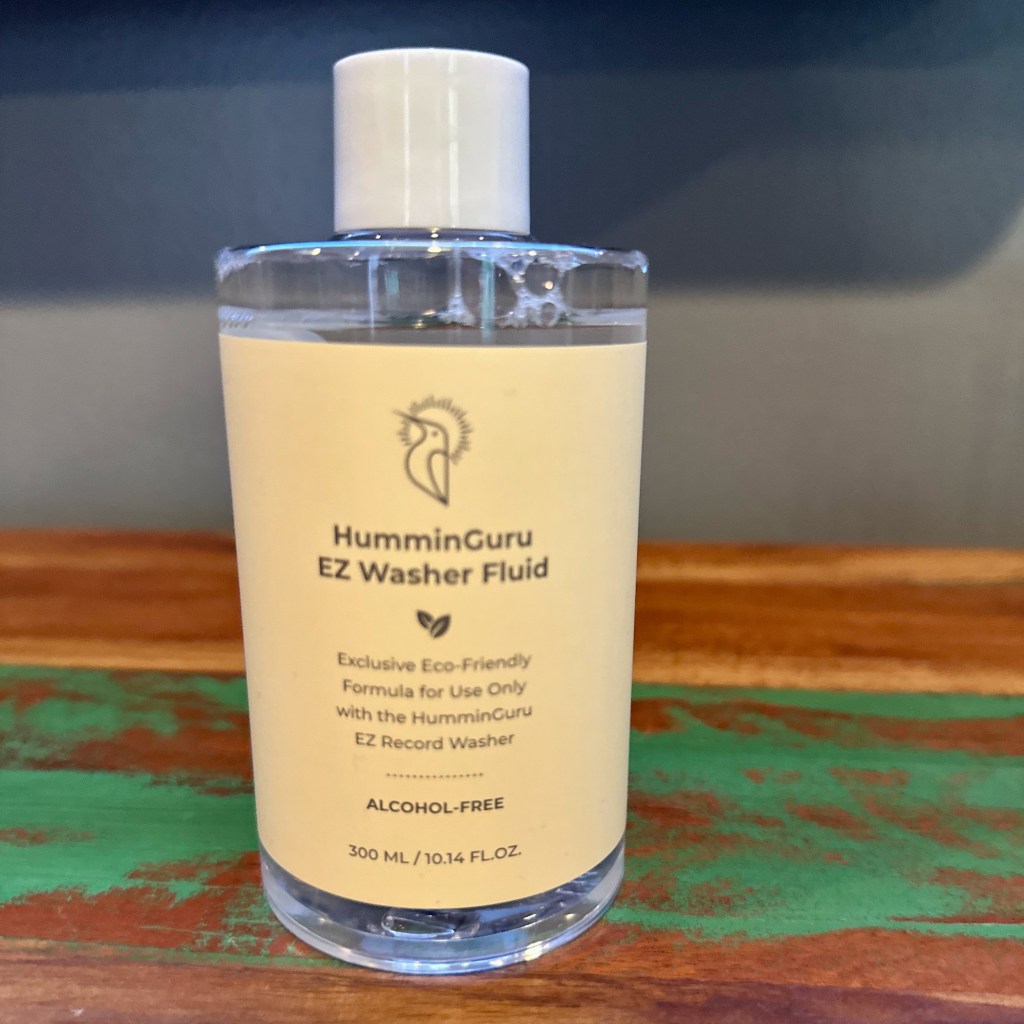
The Cleaning Solution
HumminGuru includes an alcohol-free cleaning solution that’s designed specifically for the washer. Two capfuls are mixed into the 950 mL basin, and that amount is intended to clean roughly 10–20 records before refreshing the solution, depending on how dirty the collection is
Could you use something else?
Technically, yes. There are several reputable record-cleaning concentrates on the market that are designed for manual wet cleaning.
That said, unless you already have a preferred cleaning chemistry, I’d recommend sticking with the included solution at first. It’s inexpensive when refills are needed, alcohol-free, and designed specifically for the goat-hair brush system. Once you’ve established a baseline, experimenting with alternatives becomes much easier.
How Many Records Can You Clean?
The honest answer is it depends on what you’re cleaning.
A batch of brand-new records may let you clean twenty or more before replacing the water. A stack of dusty thrift-store finds? I’d change the water after about ten records, or even sooner if they were particularly dirty.
The reason for the conservative recommendation is that the HumminGuru EZ’s water reservoir is black, making it surprisingly difficult to judge just how dirty the cleaning solution has become, even under bright light. Because you can’t easily see what’s suspended in the water, it’s often better to be on the side of caution.
As a general guideline:
- Brand-new or already clean records: around 20 albums
- Average used records: 10–15 albums
- Heavily soiled thrift-store or garage-sale finds: change the water whenever you start wondering if you should
Distilled water is inexpensive and replacing it only takes a minute. Your records are worth far more than the gallon of water you’re trying to stretch.
Works with 33s and 45s
Thankfully the included clamp system supports both standard LPs and 45 RPM records with large center holes by using the included adapter. The clamp is designed for records between approximately 1 mm and 3 mm thick, covering the overwhelming majority of modern and vintage pressings.
Storage Is Better Than Expected
This might sound minor until you’ve owned a few cleaning products. The drying rack stores underneath the washer. The protective lid keeps dust out of the basin.
Everything ends up as one compact package that can easily slide onto a shelf until next time.
For apartment dwellers or anyone sharing listening space that’s a surprisingly nice touch.
Who Should Buy It?
I’d recommend the HumminGuru EZ for collectors who:
- have outgrown carbon fiber brushes
- buy used records regularly
- don’t want to spend $400–800 on ultrasonic cleaning
- want a cleaner, more modern alternative to the classic Spin-Clean
If you’re restoring rare, heavily soiled records every week, an ultrasonic machine is still the better long-term investment. But if you’re looking for the biggest improvement around the $100 mark, the EZ sits in a sweet spot between simple maintenance and true deep cleaning.
View the Spin-Clean Record Washer MKII
The Next Step in Record Cleaning
Considering the HumminGuru HG01?
If you’re ready to make the jump to ultrasonic cleaning, the HG01 is the next step. It combines ultrasonic cleaning with automatic draining and drying, substantially reducing the amount of hands-on work required.
See how it compares with the EZ in cleaning performance, drying, noise, maintenance, and overall value.
Read the HumminGuru EZ vs HG01 ComparisonA Final Note
I don’t think the HumminGuru EZ is trying to replace an ultrasonic cleaner.
It’s trying to replace the idea that meaningful record cleaning has to cost hundreds of dollars.
For many vinyl collectors, that’s exactly where it belongs.
If you’re just getting started with vinyl, you might also find our guide on What to Do After Buying a Turntable helpful. And if you’re looking to round out your setup, take a look at our recommendations for the Best Vinyl Record Brushes and our comparison of The Best Turntable Mats: Felt, Cork, Silicone, or Acrylic? Together, these simple upgrades can help you get the most from every record you bring home.
Table of Contents
- HumminGuru EZ Record Washer Review: Is It Worth Buying?
- It’s Not an Ultrasonic Cleaner and That’s Okay
- Compared with the Spin-Clean
- Initial Setup
- Distilled Water Isn’t Optional
- The Cleaning Solution
- How Many Records Can You Clean?
- Works with 33s and 45s
- Storage Is Better Than Expected
- Who Should Buy It?
- Final Note