
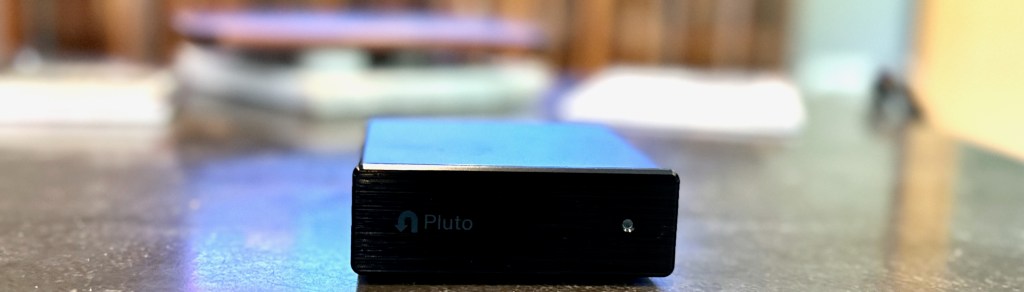
U-Turn Audio Pluto 2 Phono Preamp Review: A Small Stage That Keeps Vinyl Moving
Opening Note
For most vinyl setups, the phono stage is either built in, overlooked, or overthought.
Built-in options get the job done, but rarely invite you to stay with a record longer than you planned. Higher-end stages offer control, but often introduce decisions you may not be ready, or interested to make.
(Affiliate links are included below, but like all recommendations here, they’re about usefulness, not hype.)
The U-Turn Audio Pluto 2 sits directly between those two worlds.
It’s designed to solve a very specific problem: how to give your turntable a clean, reliable signal path without turning your system into something complicated.
What the Pluto 2 Is: A Simple MM Phono Preamp
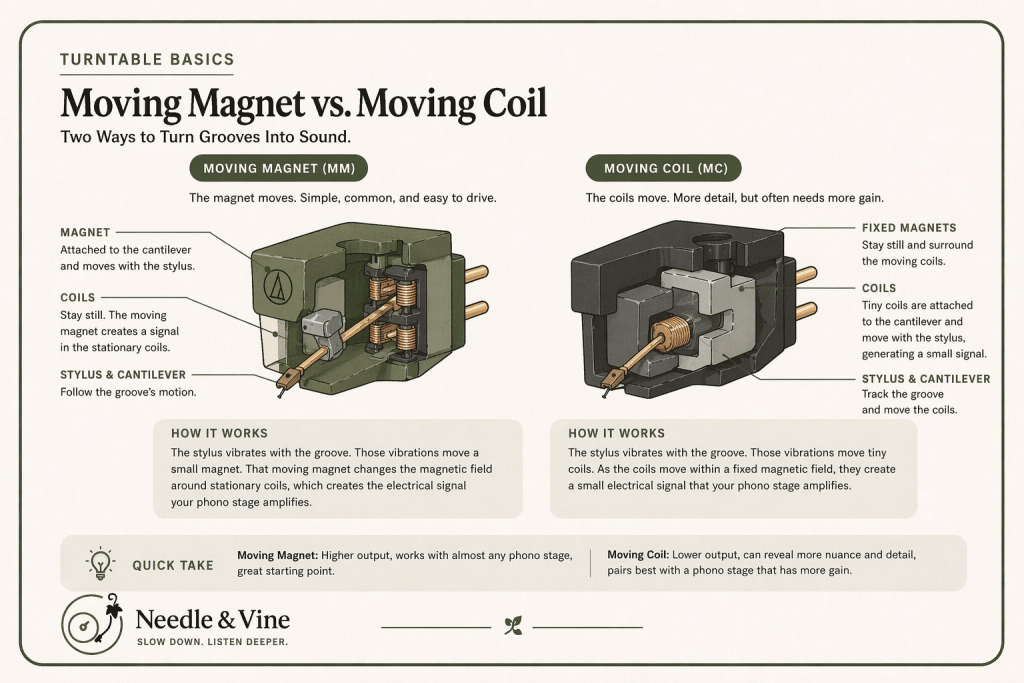
The Pluto 2 is a moving magnet (MM) phono preamp, built to take the low-level signal from your turntable and bring it up to line level for use with amplifiers, receivers, or powered speakers.
It keeps the approach intentionally narrow.
- Fixed gain
- Fixed loading
- No switches or configuration
There’s nothing to adjust because there’s nothing meant to be adjusted.
This isn’t a tool for shaping sound. It’s a tool for delivering it cleanly.
A Compact Phono Preamp That Fits Modern Vinyl Setups
One of the first things you notice about the Pluto 2 is its size.
It’s small. Very small. Just enough space to accommodate the inputs, outputs, and power. At a glance, it almost feels undersized for the role it’s meant to play.
There’s a moment where you might question it. No way something this compact can actually carry the signal the way a traditional component does. But after a few records, that hesitation fades.
The Pluto 2 proves to be more capable than its footprint suggests, and that small form factor quickly becomes an advantage rather than a compromise.
In my case, that flexibility mattered.
I wanted a second setup in my office, something that didn’t require the full chain of a traditional system. No large receiver, no dedicated rack, no excess.
Just a clean, contained signal path. The Pluto 2 made that possible.
Connected to a Sonos Era 100 through a simple Sonos line-in adapter, it becomes part of a very different kind of setup. One that trades scale for simplicity, but still keeps vinyl at the center.
From there, the signal doesn’t stop in the room.
It moves.
Across the house, into other spaces, into a broader listening environment that fits more naturally into how music actually gets used day to day.
If you’ve read some of my other articles, you know I’ve leaned heavily into the Sonos ecosystem. This kind of integration matters more than it might seem on paper, and the Pluto 2 makes it easy.
No friction. No complexity.
Just a small piece that connects analog listening to a more flexible, modern system.
How to Connect a Turntable to Speakers or Sonos
Setup is immediate and straightforward.
Turntable connects to the input.
Ground wire secures to the post.
Output runs to your amplifier, speakers, or streaming input.
From there, it simply works.
In a system like min with a Pioneer PL-12D, paired with either a vintage receiver or a modern powered setup, the Pluto 2 doesn’t call attention to itself. It removes the friction that often exists between components and lets the system settle into place.
There’s no sense of calibration or tuning.

Just connection, and playback.
Pluto 2 Sound Quality and Listening Impressions
Balanced, Quiet, and Unforced
The Pluto 2 leans toward neutrality, but not in a way that feels clinical.
What stands out most is what doesn’t happen.
- No added weight in the low end
- No sharpness in the highs
- No noticeable coloration
Instead, it presents music with a sense of balance that feels stable and consistent across different records.
On Getz/Gilberto, the space between instruments remains intact, with enough air to let the performance breathe.
On Hot Buttered Soul, the low end carries through with presence, but without becoming heavy or overwhelming.
The noise floor stays low, which becomes more noticeable during quieter passages and between tracks.
It doesn’t elevate or reshape the music.
It simply lets it pass through without resistance.
Best Use Cases for a Budget Phono Preamp
The Pluto 2 works best in systems where simplicity is part of the goal.
- As an upgrade from built-in phono stages
- In vintage turntable setups paired with modern gear
- In secondary listening spaces or compact setups
- In systems built around consistency rather than experimentation
It’s especially well-suited for listeners who want their system to feel settled, not constantly in progress.
Limitations of the Pluto 2 Phono Preamp
That simplicity comes with limits.
- No support for moving coil (MC) cartridges
- No gain or loading adjustments
- No flexibility for system tuning
If your system is evolving toward more specialized cartridges or more intentional sound shaping, the Pluto 2 will eventually feel restrictive.
But for many setups, those limitations never become an issue.
Build Quality and Compact Design
The physical design follows the same philosophy as the circuitry.
Compact. Minimal. Purpose-driven.
There’s no excess in the enclosure, no unnecessary interface. Connections are clearly laid out, and once installed, it disappears into the system both visually and functionally.
It feels less like a feature piece and more like a permanent part of the signal chain.
Price and Value: Phono Preamp Under $150
- New: Around $130
- Used: Typically $70–$90
At this level, the Pluto 2 sits comfortably above most built-in stages and entry-level externals, offering a cleaner and more consistent presentation without pushing into higher-end pricing.
- A simple, reliable phono stage that keeps your signal clean without adding complexity. Small footprint, low noise, and easy to integrate into both vintage and modern setups.
Final Note
The Pluto 2 isn’t designed to change your system.
It’s designed to stabilize it.
It removes the uncertainty between components and replaces it with something predictable, consistent, and easy to live with. Not in a way that stands out, but in a way that allows everything else to.
And in smaller, more flexible setups, that role becomes even more important.
Because when the equipment gets out of the way, the listening has more room to move.
And once that happens, the system starts to feel less like a collection of parts and more like something you return to without thinking.
If you’re just getting started, or even refining a second setup, it can also help to spend a little time with how the rest of the system comes together. We’ve walked through that more fully in our Pioneer PL-12D setup and restoration piece, along with a broader guide on what to do after setting up your turntable.
Both are less about adding more gear, and more about getting more out of what’s already in front of you.
Table of Contents
- Opening Note
- What the Pluto 2 Is
- A Compact Phono Preamp That Fits Modern Vinyl Setups
- How to Connect a Turntable to Speakers or Sonos
- Pluto 2 Sound Quality and Listening Impressions
- Best Use Cases for a Budget Phono Preamp
- Limitations of the Pluto 2 Phono Preamp
- Build Quality and Compact Design
- What You’ll Expect to Pay
- Final Note