
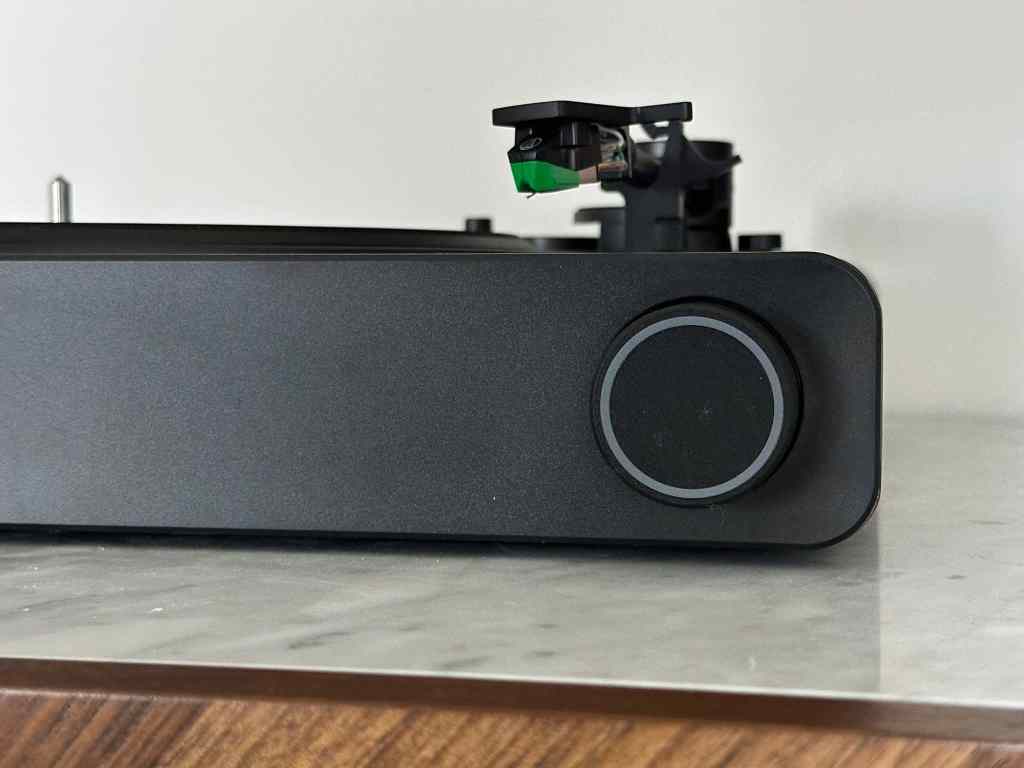
Victrola Stream Onyx Review – Sonos Vinyl Turntable
At Needle & Vine, we spend most of our time living in an analog world, but we’re not pretending the digital one doesn’t exist. Convenience has its place, especially when it doesn’t ask you to give up the ritual. That’s where the VPT-2000-BLK-ATE more commonly known as the Victrola Stream Onyx enters the picture.
I already have a solid analog stack built for one thing: playing records well. What it didn’t do was integrate cleanly with the Sonos speakers spread throughout the house. Different systems, different strengths, no easy overlap. The Stream Onyx wasn’t about replacing what I already had, it was about adding an option.
I bought it with a specific goal in mind: the ability to play vinyl records in a digital home without turning the experience into a compromise. Same records, same habits, just a wider reach. Whether it actually delivers on that idea is where things get interesting and where this review really begins.
Now, what this article is not. There are plenty of unboxing videos and first-impression walkthroughs of the Victrola out there. We’re not here for that. This isn’t about foam inserts, setup checklists, or watching someone peel plastic off a plinth.
What we are interested in is how the VPT-2000-BLK-ATE fits into an existing listening flow, especially if you already think of yourself as an audiophile. How it behaves alongside a traditional turntable. Where it complements a well-built analog system, and where it clearly doesn’t try to compete.
We’ll talk about what it does well, what it does less convincingly, and why that distinction matters if you already have a conventional deck doing the heavy lifting. If you’re looking for a step-by-step setup guide, there’s no shortage of content waiting for you elsewhere.
But if you want to understand how this table can live comfortably between the analog rituals you care about and the digital convenience that’s hard to ignore, stick around.
Quick Verdict
The Victrola Stream Onyx (VPT-2000-BLK-ATE) is best understood as a bridge between analog ritual and modern streaming convenience.
It integrates cleanly with Sonos and feels solidly built, making it a compelling option for listeners who want vinyl throughout a connected home.
Purists running a dedicated analog chain may find the internal processing and app dependency limiting, but for whole-home listening it fills a niche few turntables attempt.
Materials, Weight & Presence
From the moment you set it down, you might be surprised by how solid the Victrola feels. There’s real heft here, not excessive, not ornamental but enough mass to signal intention. It doesn’t feel hollow or rushed. It feels planted.
The plinth has a reassuring density, and the overall construction gives the impression that this wasn’t built to be disposable. Controls have resistance. The finish feels deliberate. Nothing about it suggests corner-cutting.
At roughly $650 on Amazon at the time of this writing, that level of build quality should be expected. Still, we’ve come across more than a few turntables in this price range that didn’t quite deliver lightweight chassis, loose tolerances, materials that felt more cosmetic than structural. The Stream Onyx avoids that trap. It feels like a product designed to be used, not just displayed.
Before you ever drop a record on it, that matters.
Minimal by Design
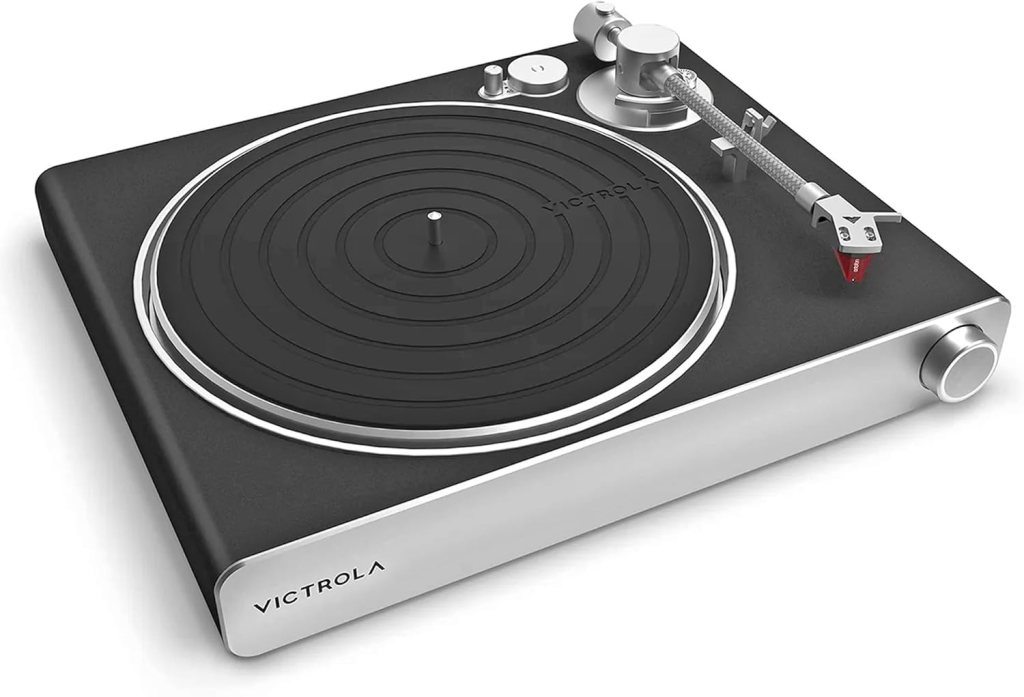
At first glance, the Victrola leans into restraint. The deck is clean, almost sparse, with only the essentials exposed. No clutter. No decorative distractions. Just the controls required to play records properly.
You’ll find manual speed selection (33/45), a 45 RPM adapter, adjustable anti-skate, a tonearm counterweight, and a cue lever for controlled drops. That’s it. Everything present has a purpose.

Up front sits a single control knob that manages volume for the built-in amplifier. And this is where things become worth clarifying.
The Stream Onyx includes an internal phono stage and amplification, meaning it outputs a line-level signal through its RCA outputs. In practical terms, that allows you to connect it directly to powered speakers or any amplifier’s standard line input without needing a separate phono preamp.
If you already run a traditional analog stack with a dedicated phono stage, that internal circuitry becomes more of a convenience layer than a necessity. You are not sending a raw cartridge signal downstream, you are sending a processed, line-level output.
That distinction matters. For some listeners, built-in electronics are a compromise. For others, they’re what allow vinyl to live in more rooms than just one.
The Stream Onyx knows which side of that line it’s on.
One other design choice worth noting is the dust cover. Rather than a traditional hinged lid attached to the rear of the plinth, the Stream Onyx uses a slim, fully removable acrylic cover. It protects the table well and visually reinforces the modern, minimal aesthetic. But it does mean removing the cover entirely before playback rather than simply lifting it.
If you’re accustomed to a classic lift-up cover that stays attached and can remain open during a listening session, this approach may feel less convenient. It’s not necessarily a flaw, just a departure from traditional turntable design. Another small signal that this table was built with a contemporary space in mind.
Minimal, yes but interpreted through a modern lens.
Signal Path & Purity
This is where the Stream Onyx reveals what it truly is.
As mentioned earlier, I bought the Victrola to solve a specific problem, Sonos integration. In that role, it generally performs well. Records can move beyond a single room. Vinyl becomes whole-home. That part works.
But streaming vinyl introduces a reality that’s hard to ignore: delay.
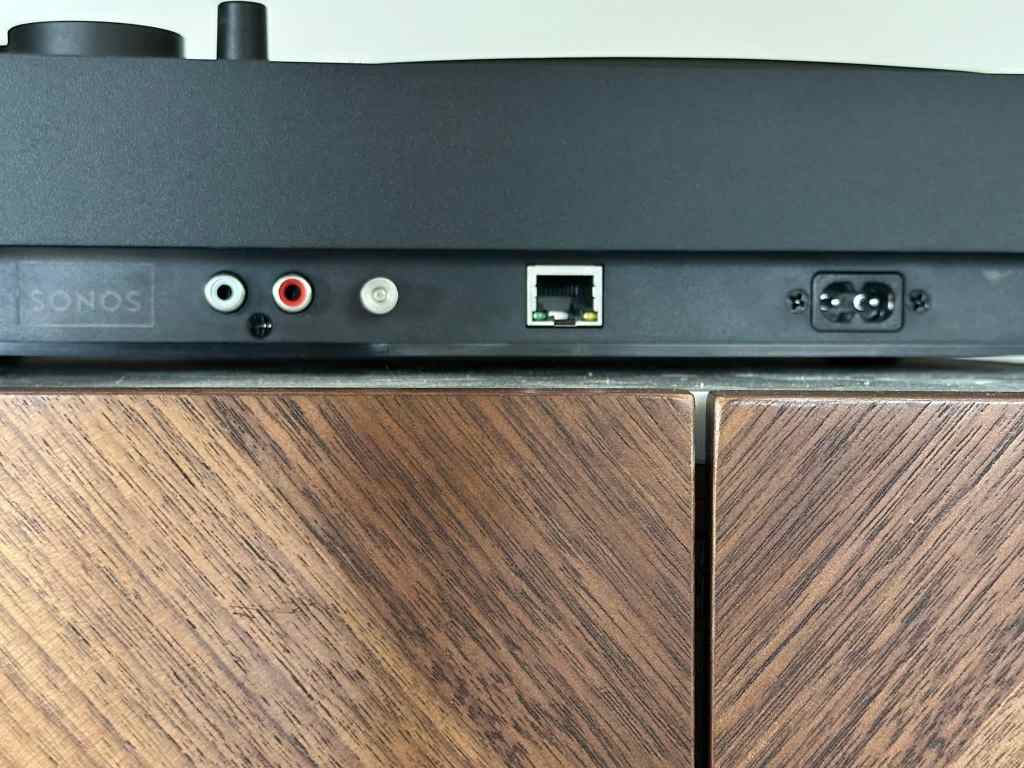
There is noticeable latency when audio is routed through Sonos. It’s not broken, and it’s not inconsistent, but if you’re accustomed to the immediate response of a purely analog deck, the slight lag between action and sound can feel unnatural.
On the analog side, I attempted to integrate the Victrola’s RCA outputs into one of my external preamps to see how comfortably it could live in a more conventional system. This is where things felt less settled.
Because the table includes an internal phono stage and amplification, you’re not sending a raw cartridge signal into your preamp. You’re feeding it a processed line-level output. Dialing in the right gain between the turntable’s volume control and the external analog equipment required more adjustment than expected. It never quite felt as balanced or as direct as a purely passive deck feeding a dedicated phono stage.
There’s also a subtle sense that the digital architecture remains in the chain even when you’re using it in a traditional analog setup. It doesn’t sound broken. It doesn’t sound bad. But it doesn’t disappear the way a fully manual table can.
And that distinction matters.
The Stream Onyx is at its best when you let it be what it was designed to be: a bridge. When you try to make it behave like a reference analog deck, it reminds you that it was built with a different priority.
Where the Victrola Stream Onyx Excels
When you stop trying to make the Stream Onyx behave like a traditional analog deck and instead let it do what it was designed to do, it starts to make a lot more sense.
Its strength is reach.
The ability to drop a record in one room and have it fill the rest of the house through Sonos is genuinely compelling. There’s something quietly satisfying about hearing vinyl travel beyond the listening chair. Kitchen. Office. Patio. It turns what is normally a stationary ritual into something more fluid.
And to its credit, it does this without turning vinyl into something disposable. You’re still handling records. Still cueing a tonearm. Still flipping sides. The ritual remains intact, it’s just no longer confined.
Setup inside the Sonos ecosystem is straightforward. Once connected, it behaves predictably. For households already invested in Sonos, the Stream Onyx removes the friction that typically keeps turntables isolated from whole-home audio systems.
Most importantly, it lowers the barrier to entry for vinyl in a modern home. Not everyone wants to build a separate analog stack in every room. Not everyone wants to think about phono stages and gain structure. The Stream Onyx makes vinyl accessible without completely stripping away what makes it meaningful.
That’s not a small achievement.
The Victrola App Experience
No matter how analog the ritual feels, the Stream Onyx ultimately relies on software to complete its promise. And that means living, at least partially, inside the Victrola app.

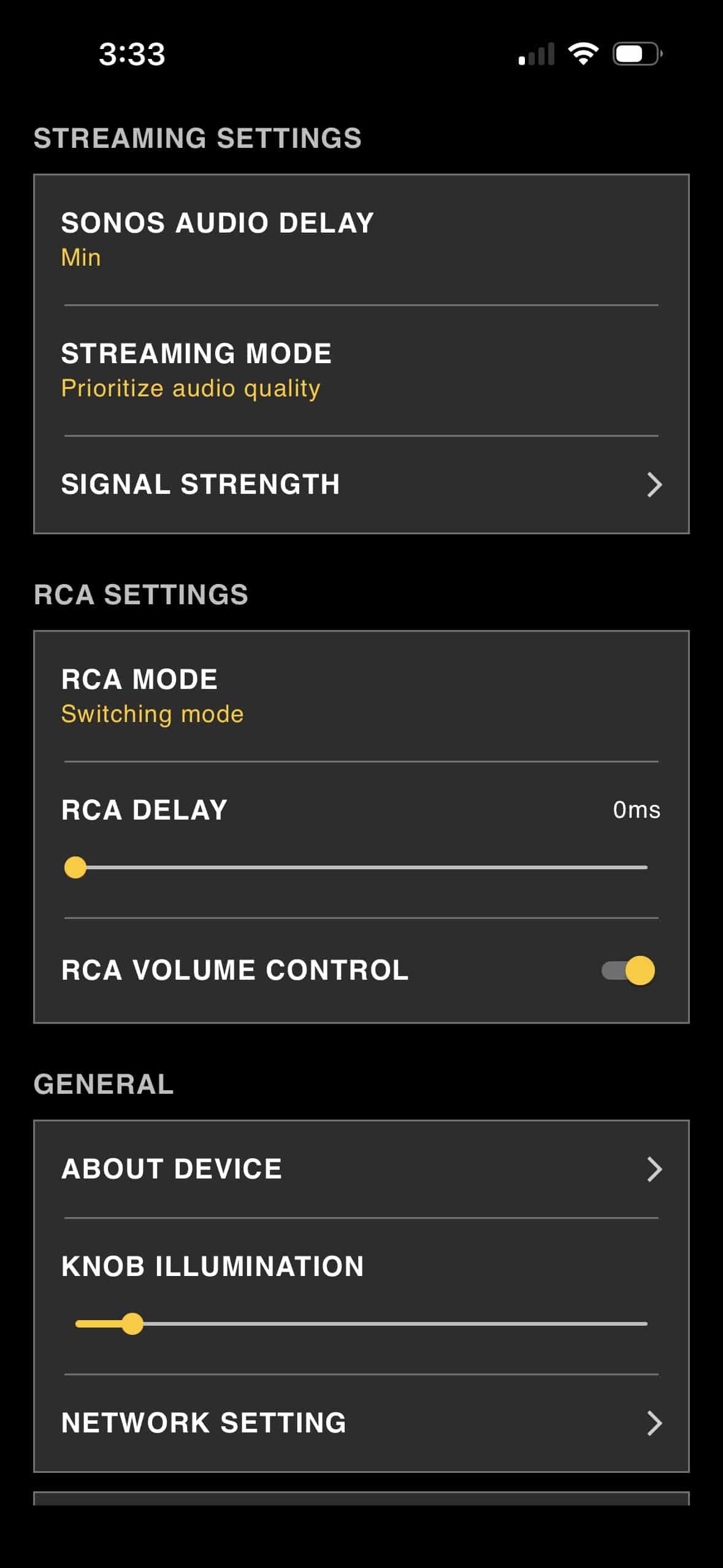

Setup flows through the app. Wi-Fi configuration, Sonos pairing, firmware updates, all of it runs through that digital layer. To its credit, initial setup is relatively straightforward. If you’re already comfortable navigating the Sonos ecosystem, nothing here feels foreign.
But this is also where the experience shifts from tactile to transactional.
The app introduces an extra step between you and the music. Switching rooms, managing playback routing, adjusting output behavior, these things aren’t handled purely from the hardware. They require a screen. And while that’s expected for a streaming-enabled device, it does subtly alter the rhythm of vinyl listening.
There were moments where small delays, reconnections, or brief pauses reminded me that this table is operating in two worlds at once. Nothing catastrophic. Nothing broken. But enough friction to notice if you’re accustomed to purely mechanical playback.
The app works. It’s functional. It does what it needs to do.
It just doesn’t disappear.
And that may be the most honest way to frame the Stream Onyx as a whole. The hardware feels grounded and intentional. The streaming works well within the Sonos environment. But the digital layer app included is always present in the background.
For some listeners, that’s the cost of flexibility. For others, it’s a tradeoff worth making.
The Cartridge: A Sensible Starting Point
The Stream Onyx ships with the Audio-Technica AT-VM95E, an elliptical cartridge that has quietly become something of a modern standard in the mid-range market.
That’s a good thing.
This is not a throwaway starter cartridge designed to simply get sound out of a box. The VM95E tracks reliably, handles inner grooves with reasonable composure, and offers a balanced presentation that leans neutral rather than exaggerated. Highs are clean without becoming brittle. Midrange remains articulate. Bass is controlled, if not especially weighty.
For many listeners, it will be more than sufficient out of the gate.
That said, context matters.
In a purely analog signal chain, the VM95E is capable of scaling with better phono stages and cleaner gain. On the Stream Onyx, however, the cartridge exists inside a digitally mediated architecture. It performs competently, but you’re unlikely to extract the last ounce of nuance the cartridge is capable of in a reference setup.
There’s also the question of ceiling.
The VM95 platform is modular, stylus upgrades (like the VM95EN or VM95ML) are available without replacing the entire cartridge body. In theory, that gives the Stream Onyx an upgrade path. In practice, the table’s internal electronics mean you may encounter diminishing returns if you move too far up the stylus ladder.
So where does that leave it?
The included cartridge is a smart choice. It’s not entry-level in the disposable sense. It’s not audiophile-aspirational either. It sits comfortably in the middle, competent, dependable, and aligned with what this table is trying to accomplish.
For a turntable designed to bridge analog and digital worlds, that feels appropriate.

Strengths & Tradeoffs
After spending time with the Stream Onyx in both analog and Sonos-driven listening sessions, a few clear strengths and limitations emerged.
Pros
- Excellent Sonos integration
- Solid build quality for the price
- Respectable AT-VM95E cartridge included
- Enables whole-home vinyl listening
Tradeoffs
- Streaming introduces latency
- Internal electronics limit pure analog signal path
- Removable dust cover instead of hinged lid
- App dependency for some functionality
Where to Find It
Disclosure: Some links on this page are affiliate links. If you make a purchase through them, Needle & Vine may earn a commission at no additional cost to you.
If you decide the Stream Onyx makes sense for your space, here are the current listings:
Victrola Stream Onyx (VPT-2000-BLK-ATE)
A solid bridge between analog ritual and Sonos integration.
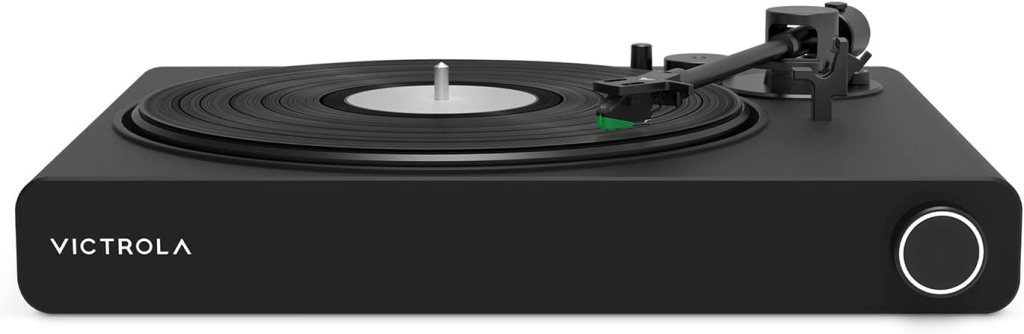
Victrola Stream Carbon (VPT-3000-SLV)
A step up in materials and refinement for those who want a more premium execution.
Just Getting Started?
If you’ve recently purchased the Victrola or you’re seriously considering it, take a moment before dropping your first record.
Even a modern, streaming-enabled table benefits from a little setup discipline. Proper placement. Basic cleaning habits. Stylus care. Small steps that protect both your records and the turntable itself.
If you’re new to vinyl, or returning after some time away, we put together a practical guide that walks through what to do next without overwhelming you with gear jargon.
Final Pour
The Stream Onyx is not trying to replace a reference analog deck. It isn’t chasing purist approval, and it doesn’t pretend to be something it’s not.
What it offers is flexibility.
If you live entirely inside a dedicated listening room, already running a dialed-in preamp and a carefully chosen cartridge, this table may feel like a compromise. The internal processing, the streaming layer, the app dependency, all of it gently reminds you that this is vinyl translated for a different kind of home.
But if your records are meant to move with you from listening room to kitchen, from office to patio the Stream Onyx opens doors that traditional decks simply don’t.
It preserves the ritual while expanding the reach.
And for many setups, there’s still room to shape the sound further. Even here, a thoughtful cartridge upgrade can bring a little more balance and clarity to what you’re hearing, something worth exploring once the rest of the system settles in.
That may not satisfy the strictest definition of signal purity. But for the listener balancing analog affection with digital convenience, it makes a compelling case for coexistence.
And maybe that’s the point.
Not every table has to live in one world. Some are built to stand between them.
Whether your listening life leans modern or vintage, we’ve also spent time with the Yamaha YP-800, a table built with entirely different priorities.