
Sansui 2000X Review: A Vintage Receiver That Changes How You Listen
Not every piece of gear shows up to replace something. Some arrive to open things up.
I picked up the Sansui 2000X receiver off eBay with that in mind. Not to push out the NAD 1020 preamplifier that’s already been anchoring my system, but to give it another direction to move in. Another way to listen.
The 1020 is steady. Clean. Controlled.
But a receiver like the 2000X brings something different into the room. More flexibility. A little more presence. The kind of shift that changes not just how things sound, but how you settle into them.
It’s not about upgrading. It’s about expanding.
And sometimes, that’s exactly what a system needs.
A First Look at the Sansui 2000X Receiver
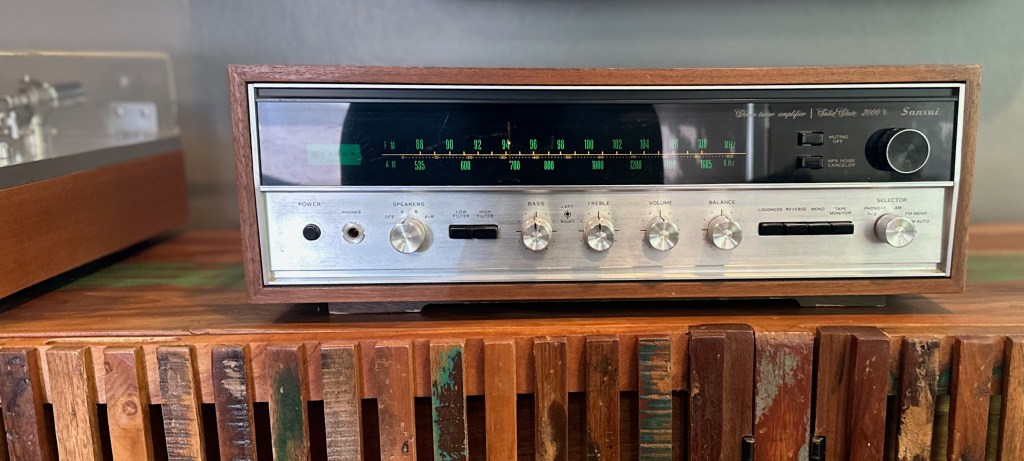
Before a single note plays, the Sansui 2000X receiver makes an impression.
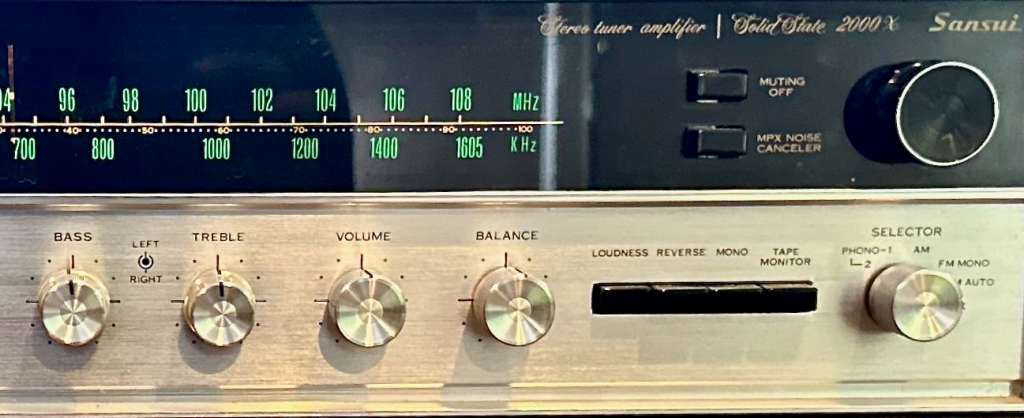
There’s weight to it. Not just in how it feels, but in how it presents itself. The brushed aluminum faceplate, the spacing of the controls, the wood cabinet wrapping it all together, it doesn’t feel like equipment as much as it feels like something that belongs in the room.
The layout is deliberate.
Large, knurled knobs with real resistance. Switches that click with intention. A tuning dial that doesn’t rush. Everything about it slows you down just enough to notice what you’re doing.
That’s the difference.
Modern gear tends to disappear until you need it. The 2000X does the opposite. It invites interaction. It asks you to be part of the process. Even before it’s powered on, you get a sense of what it’s built for.
Not convenience. Presence.
Vintage Marketplace
Looking for a Sansui 2000X?
Compare current listings, prices, and condition on eBay.
Affiliate link. Price and availability may change.
Browse Sansui 2000X ListingsSansui 2000X Specifications and Features
| Feature | Details |
| Power Output | 39 watts per channel (8 ohms) |
| Amplifier Type | Solid-state stereo receiver |
| Inputs | Phone (2), AUX, Tape |
| Outputs | Speaker A/B, Headphone |
| Controls | High/Low filters, Loudness, Reverse/Mono, Bass/Treble |
| Phono Stage | Built in MM phono preamp |
| Tuner | FM Mono/Stereo, AM |
| Era | Early 1970s |
| Build | Metal faceplate, wood cabinet |
On paper, it’s modest. In practice, it’s something else entirely.
Sansui 2000X Sound Quality
The first thing you notice isn’t detail. It’s ease.
The Sansui 2000X receiver doesn’t push forward or try to impress in the way a lot of modern gear does. It doesn’t spotlight individual elements or sharpen edges just to make a point. Instead, it settles everything into place.
There’s a warmth here, but it’s not heavy or colored for effect. Bass carries weight without feeling oversized. Highs stay smooth, never reaching for brightness. And the midrange where most of the music actually lives feels full, steady, and grounded. Vocals sit where they should. Instruments don’t compete. Nothing feels pulled apart just to be heard.
If you’re coming from something like the NAD 1020 preamplifier, the difference is immediate. The 1020 leans toward control and clarity. It defines edges. It separates.
The 2000X does something else. It blends.
Not in a way that loses detail, but in a way that makes the whole presentation feel cohesive. Less like a collection of parts, more like a single performance happening in front of you. That shift changes how you listen. You stop tracking individual elements. You stop listening for differences. And somewhere along the way, you stop thinking about the system altogether.
You just let the record play. And with the 2000X, that tends to last longer than you expect.
Power, Pairing, and System Flexibility
On paper, the Sansui 2000X receiver isn’t chasing big numbers. And in practice, it doesn’t need to.
Rated at modest power, it’s easy to underestimate what it can do. But paired correctly, the 2000X has a way of filling a room without ever feeling like it’s working for it. The sound stays composed. Nothing strains. Nothing hardens as you turn it up.
That’s where pairing matters.
With efficient speakers something in the vein of classic bookshelf designs or vintage-leaning floorstanders the 2000X feels completely at home. It doesn’t need to muscle through difficult loads. It just settles in and lets the system breathe.
This is less about chasing volume and more about sustaining presence. But where the 2000X quietly separates itself is in flexibility. One detail that stands out right away is the presence of two phono inputs. Relatively common on mid to higher end gear of the day, and not something you think about until you have it.
It opens up options.
Two turntables, each with a different cartridge. A dedicated mono setup alongside a stereo deck. Or simply the ability to switch between tables without touching cables or reconfiguring your system.
It’s a small feature on paper. In practice, it changes how you use the system.
And that same philosophy carries through the rest of the receiver. Unlike a dedicated preamp like the NAD 1020 preamplifier, the 2000X brings everything into one place. Amplification, inputs, switching, it’s all contained.
That opens up even more possibilities.
You can run a simplified system straight through the receiver and keep things self-contained. Or, if you’re already working with separate components, the 2000X can step in as an alternate path, a different way to route your listening without tearing everything apart.
It’s not about replacing your setup. It’s about giving it range.
Some nights, you want control and precision. Other nights, you want something a little more relaxed, a little more immediate. The 2000X makes room for both.
Using the Sansui 2000X Alongside the NAD 1020
This is where the Sansui 2000X receiver starts to make more sense. Not on its own, but in the system.
Right now, the chain looks like this:
Yamaha YP-800 turntable → NAD 1020 preamplifier (phono) → Sansui 2000X (Aux)
The 1020 shapes the signal in a way I’ve gotten used to. It tightens things slightly, adds a bit of control, and brings a certain familiarity to the presentation. By the time it reaches the 2000X, the character is already set and the Sansui carries it forward with its own sense of weight and cohesion.
It’s a layered sound. Not overly processed. Just… intentional.
And then there’s the second phono input. That’s where things open up.
Phono 2 has quietly become a testing ground. A place to drop in another table without disturbing what’s already working. Most recently, that’s been the Pioneer PL-12D turntable running side by side, ready to be compared, adjusted, or just listened to without needing to rewire anything.
That kind of flexibility changes how you interact with the system. You’re not committing to one path. You’re not breaking things down to try something new. You’re just switching inputs and continuing the session. And over time, that starts to matter more than you expect.
There’s also the question I haven’t fully answered yet.
At some point, I may bypass the 1020 entirely running the Yamaha straight into the Sansui’s phono stage and letting it handle everything on its own. It would be simpler. Cleaner. Probably closer to how this receiver was originally intended to be used.
But right now, I’m used to what the 1020 brings into the chain. That added layer. That slight shaping of the signal. It’s become part of how I hear the system.
Maybe that changes over time. Maybe it doesn’t.
That’s part of the process. Because this setup isn’t about finding a single “correct” path. It’s about having more than one and taking the time to understand what each one brings with it.
Inputs, Tape Loops and What Still Matters
Around the back of the Sansui 2000X receiver is where its age shows and where some of its value still lives. By modern standards, it’s simple. No digital inputs. No streaming. No shortcuts.
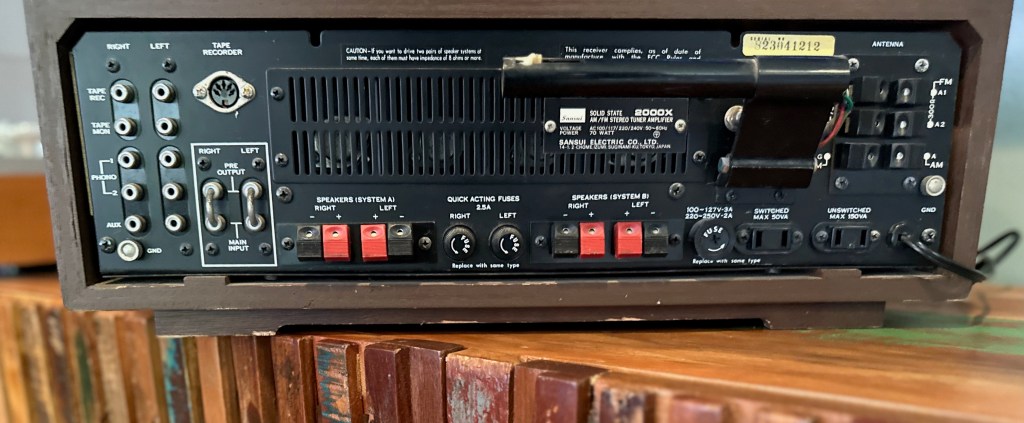
Just RCA connections, clearly labeled and easy to follow. Phono, AUX, tape in, tape out. That’s the system. And within that simplicity, there’s a level of flexibility that’s easy to overlook, especially if you’re used to newer gear.
The two phono inputs already stand out. They give you room to run multiple turntables without compromise. No switching cables. No external boxes. Just select and play.
But the tape loop is where things get more interesting.
Originally, it was designed for a different kind of setup. Recording from vinyl to tape, monitoring playback, inserting external processors into the signal path. It was part of a more hands-on way of listening.
Today, most of that use case is gone. But the function remains.
The tape loop still gives you a fixed path in and out of the receiver. A way to step outside the main signal flow without breaking it. You can introduce another component, test a different configuration, or simply route audio in a way that modern systems don’t always make easy. It’s not a modern “feature.” It’s a leftover from a different way of building systems. And that’s really the point. The 2000X doesn’t try to do everything. It gives you just enough to build around and expects you to meet it halfway.
For a lot of setups, that simplicity will feel limiting. But if you’re working with analog sources, and you’re willing to engage with the system a little more directly, it ends up being more flexible than it first appears.
Not because it does more. Because it leaves room for you to do more with it.
What You’ll Expect to Pay
The Sansui 2000X receiver sits in a part of the vintage market that still feels accessible. Not overlooked, but not inflated either.
Most examples fall into a fairly predictable range:
- $150 – $250 Working, but unserviced. Expect cosmetic wear, scratchy controls, and some uncertainty around long-term reliability.
- $250 – $400 Cleaner units with better cosmetics. Likely functional, but still original internally.
- $400 – $600+ Serviced or restored units. Capacitors replaced, controls cleaned properly, and ready for regular use.
That spread matters.
Because with vintage gear, you’re not just buying the receiver, you’re buying its history. A lower-priced unit can absolutely be worth it, especially if you’re comfortable doing some cleanup or minor work. But it’s rarely “plug and forget.” There’s usually a little effort involved in getting it where you want it.
On the other end, a properly serviced 2000X carries a different kind of value. Not just in reliability, but in consistency. You know what you’re getting every time you power it on.
Cosmetics also play a bigger role than you might expect. The faceplate, knobs, and wood cabinet define how the receiver feels in the room. Small details, clean lettering, intact veneer, smooth controls can shift the experience just as much as internal condition.
And then there’s timing.
Prices on pieces like this tend to move slowly, but they do move. Clean examples are getting harder to find, and as more people look toward vintage systems for vinyl playback, demand follows. The 2000X hasn’t reached the level of some of Sansui’s higher-end models. But it doesn’t need to. Part of its appeal is that it still feels within reach.
Who the Sansui 2000X Is For
The Sansui 2000X receiver isn’t trying to be everything. And that’s exactly why it works. This is a receiver for a certain kind of listener, the kind who values how a system feels as much as how it measures.
It makes the most sense if:
- You listen to full sides, not just tracks
- You prefer warmth and cohesion over sharp detail
- You’re building around vinyl as your primary source
- You want flexibility without constant rewiring (especially with two phono inputs)
- You enjoy interacting with your system, switching inputs, adjusting controls, being part of the process
There’s a rhythm to using something like this. You don’t rush through it. You settle into it.
It may not be the right fit if:
- You want modern connectivity (Bluetooth, streaming, digital inputs)
- You prioritize clinical detail or analytical sound
- You’re driving inefficient, power-hungry speakers
- You want a “set it and forget it” system
This isn’t a background component. It asks for a little attention in return for what it gives you. And if your listening habits lean toward exploration, trying different turntables, comparing cartridges, adjusting your signal chain, the 2000X quietly becomes more useful over time.
Not because it does more than everything else. But because it gives you more ways to use what you already have.
Final Note
The Sansui 2000X receiver doesn’t try to win you over all at once. It builds over time.
At first, it’s the look. The weight. The way it settles into the room. Then it’s the sound, steady, cohesive, easy to stay with. And eventually, it’s the way it fits into everything else. The flexibility, the extra phono input, the ability to shift your system without tearing it apart.
That’s where it starts to matter.
Paired alongside the NAD 1020 preamplifier, it’s not competing for a role. It’s creating another one. Another path through the same records. Another way to hear what you already know.
Some nights, that difference is subtle. Other nights, it’s the reason you keep flipping the record instead of stopping after one side.
And that’s really what this comes down to. Not specs. Not power. Not even nostalgia.
Just time spent listening and having more than one way to do it.