

Miles Davis Kind of Blue Vinyl Review: Why This Jazz Classic Still Feels Timeless
Kind of Blue doesn’t try to fill the room. It changes the atmosphere around it instead.
Wine Score: ★★★★☆ (4/5)
Album Score: ★★★★★ (5/5)
Scores reflect my personal experience, less about perfection, more about vibe.
It doesn’t arrive with force or spectacle. It settles into the room slowly, almost conversationally, until you realize the atmosphere around you has changed. More than sixty years later, Miles Davis’ 1959 masterpiece still feels less like a recording and more like a space you enter.

The Listening Ritual
Before the needle drops, set the tone. Whether you’re revisiting this album or hearing it for the first time, here’s how to experience it fully.
🎧 Start the Record
Stream the album on your preferred platform and settle into the mood before the first side begins.
🍷 Pour the Pairing
Bring the full experience together with a bottle that complements the character of the record.
Availability may vary by location.
🎵 Own the Record
For readers who want the full analog experience, here’s where to track down the album on vinyl.

The Album That Changed Jazz Without Raising Its Voice
There are louder jazz records. More technically aggressive ones too. But Kind of Blue remains the album people return to because it understands restraint better than almost anything else in music.
Miles Davis moved away from dense chord changes and leaned into modal improvisation, giving the musicians room to breathe inside the compositions instead of racing through them.
The result feels remarkably modern. Nothing sounds overcrowded. Nothing feels rushed.
Even now, the album carries an almost cinematic stillness that many contemporary recordings still struggle to achieve. And because of that, Kind of Blue has become one of those rare records that works for nearly every kind of listener.
Longtime jazz collectors.
People buying their first jazz record.
Late-night headphone sessions.
Quiet Sunday mornings.
Somehow, it never feels out of place.

The Lineup Matters
The mythology surrounding Kind of Blue exists for good reason. The personnel alone reads like a foundation stone for modern jazz.
Miles Davis – trumpet
John Coltrane – tenor saxophone
Cannonball Adderley – alto saxophone
Bill Evans – piano
Wynton Kelly – piano (“Freddie Freeloader“)
Paul Chambers – bass
Jimmy Cobb – drums
What makes the album extraordinary isn’t individual virtuosity. It’s the patience. Every player seems fully aware that silence matters just as much as the notes themselves. Bill Evans’ piano voicings drift instead of announce. Coltrane pushes gently against the edges without overwhelming the mood. Jimmy Cobb’s cymbal work barely feels attached to gravity.
And Miles himself rarely overplays.
That restraint is what gives the album its emotional weight.
Why It Sounds So Good on Vinyl
Few albums reward analog playback quite like Kind of Blue.
The space between instruments matters here. A good pressing lets you hear the air around the cymbals, the texture of the upright bass, and the softness in Evans’ piano without flattening everything into the same layer.
On vinyl, the album feels physical. Not louder. Just more dimensional.
The opening bass line of “So What” emerges slowly from silence in a way digital playback rarely reproduces with the same sense of depth.
This is also one of those records where system synergy becomes immediately noticeable. Warm cartridges tend to emphasize the intimacy. More analytical setups can reveal room tone and tape texture in fascinating ways, but sometimes at the expense of the album’s softness.
On my own setup, the Yamaha YP-800 through the NAD 1020 and Sansui 2000X leans beautifully into the album’s natural warmth without sacrificing detail.
Favorite Tracks
“So What”
Possibly the most recognizable opening in jazz history.
The bass-and-piano introduction feels suspended in air before the horns slowly enter with complete confidence.
It’s cool without trying to be.
“Freddie Freeloader”
Looser and bluesier than the surrounding tracks, largely thanks to Wynton Kelly’s piano work.
There’s an ease to this performance that makes it endlessly replayable.
“Blue in Green”
Quiet, melancholic, and almost painfully intimate.
One of the most emotionally fragile recordings in Miles Davis’ catalog.
“All Blues”
Hypnotic and fluid. The rhythm section never forces momentum.
It just keeps moving like water.
Pressing Notes and What to Look For
Kind of Blue has been reissued endlessly. And honestly, that’s both a blessing and a complication. There are excellent affordable copies available, but there are also heavily compressed budget reissues that flatten the atmosphere this album depends on.
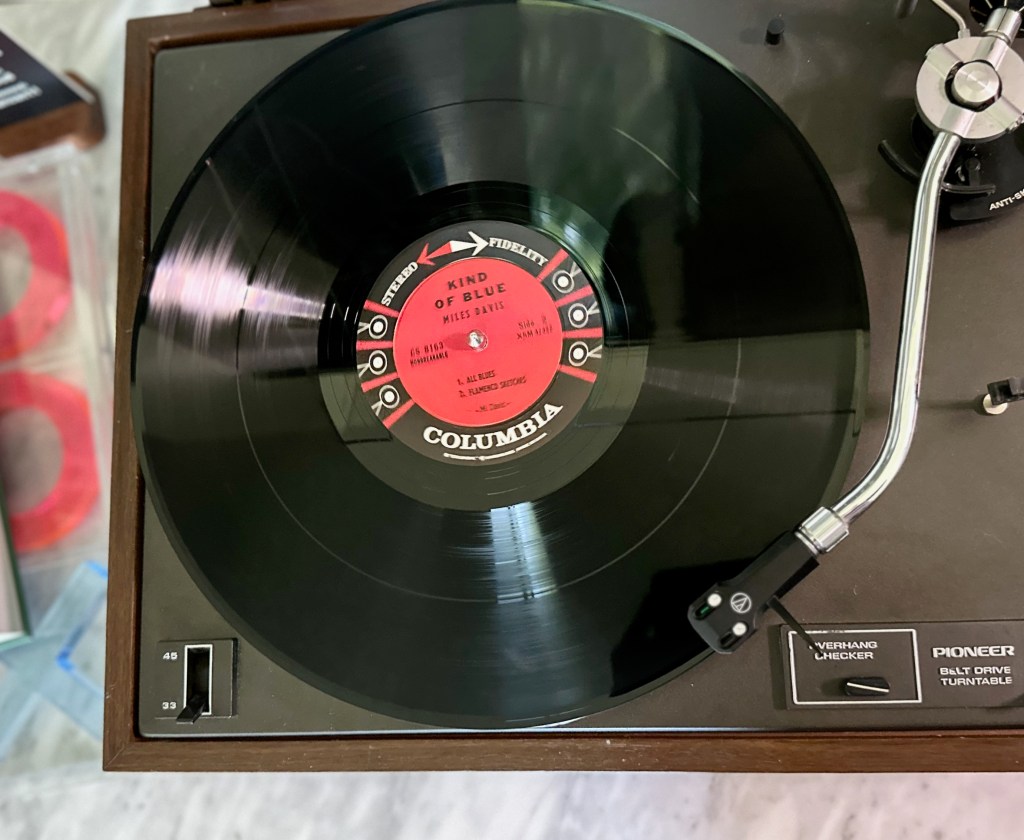
My own copy is an original Columbia six-eye stereo pressing in G+ condition, carrying matrix numbers XSM47326-1AG / XSM47327-1AJ.
That matrix sequence places it very early in the original Columbia stereo lacquer run from 1959.
The important part is the “1A” designation.
That generally indicates an early lacquer cut pulled close to the original mastering chain, long before countless later repressings and recuts entered circulation. It is also likely a Terre Haute pressing, one of the Columbia plants responsible for many of the earliest stereo copies.
And yes, it has flaws.
There are pops.
There is one skip.
The jacket shows its age.
But once the music settles in, the record still delivers something close to audio bliss. That is part of the strange magic surrounding early jazz pressings. A cleaner modern reissue may outperform it technically, but these early six-eye Columbia copies often carry a kind of dimensionality that feels deeply connected to the era that produced them.
You hear the imperfections, but you also hear the room.
Paul Chambers’ bass has physical weight. Jimmy Cobb’s cymbals shimmer softly instead of sounding etched. Miles’ trumpet hangs in space with startling presence. And Bill Evans’ piano drifts through the mix with a softness that feels almost atmospheric.
There is also the historical quirk many collectors know well: early stereo copies like this were mastered before Columbia corrected the original tape speed issue on Side One. Collectors still debate which presentation feels right.
Some listeners favor the corrected-speed modern editions for accuracy. Others feel the original-speed six-eye pressings possess a slightly dreamlike quality that became inseparable from the album’s identity. Personally, I understand why collectors continue chasing these early copies. Not because they are perfect. Because they feel alive.
Some of the most respected modern pressings include:
- Mobile Fidelity Sound Lab editions
- Analogue Productions UHQR
- Columbia Legacy mono and stereo reissues
- Classic Records pressings
Even standard Columbia Legacy reissues can sound surprisingly good for the price. The important thing is avoiding noisy or poorly mastered versions that collapse the dynamic space.
Because with this album, the silence between notes is part of the performance.
If you’re crate digging, early six-eye Columbia pressings remain highly collectible, though condition matters enormously. Kind of Blue does not hide groove wear particularly well.
Surface noise breaks the spell quickly.
But when an early pressing locks in, even imperfect copies can remind you why vinyl collectors become obsessed with records like this in the first place.
What to Expect to Pay
- Standard Reissues: Usually between $25 – 40 depending on pressing and condition.
- Audiophile Editions: Mobile Fidelity and UHQR pressings can easily range from $80 – 150+.
- Original Six-Eye Pressings: Clean originals regularly command premium pricing, especially stereo copies in strong condition.
Condition matters heavily with this album. Surface noise breaks the atmosphere quickly.
Who Kind of Blue is For
This is one of the safest “entry point” jazz records ever made. But that description can accidentally undersell it.
Yes, it’s approachable. But it’s also endlessly revealing
The better your system becomes, the more the album seems to unfold. And the older the listener gets, the more its patience tends to resonate.
That’s part of why collectors keep returning to it. Not because it demands complexity. Because it understands simplicity.

The Groove and the Glass
For Kind of Blue, I wanted something restrained rather than overpowering.
A wine with softness, texture, and enough earthiness to match the atmosphere without pulling attention away from it. The Purple Hands Lone Oak Pinot Noir 2023 ended up fitting that mood perfectly.
Its darker cherry character, subtle forest-floor notes, and silky structure mirror the same patience that defines the album itself. Nothing feels exaggerated. Nothing arrives too aggressively. It unfolds slowly, rewarding quieter attention the same way the record does.
Like the album, it becomes more compelling once the room settles down.
How to Pour
- Slightly below room temperature (around 58–62°F)
- Burgundy glass if available
- No heavy decant needed
- Best enjoyed slowly, preferably after the evening has already quieted down
This is not a pairing built for distraction.
It’s for low lighting, intentional listening, and the kind of evenings where side two somehow feels even better than side one
Charles’ Pour Notes
Wine: Purple Hands Lone Oak Pinot Noir 2023
Profile: Dark cherry, forest floor, restrained spice, silky texture
Pairing Mood: Late-night listening, dim lighting, and the kind of silence that makes every note feel intentional
There’s a softness to this Pinot Noir that fits Kind of Blue almost immediately.
Nothing feels oversized or overly expressive. The fruit arrives gently, the earthy notes linger underneath, and the texture stays smooth and composed from beginning to end. It rewards slower attention instead of demanding it.
The album works the same way.
Kind of Blue never pushes itself forward. The space between notes matters just as much as the playing itself, and every instrument seems carefully aware of the room around it. Miles Davis’ restraint, Bill Evans’ drifting piano work, and the relaxed pulse of the rhythm section all create an atmosphere that feels suspended in time.
This wine slips naturally into that environment.
Not flashy. Not attention-seeking. Just layered, calm, and immersive enough to make the room feel quieter once the needle drops.

A Final Note
Kind of Blue rarely demands your attention outright. It simply lingers long after the room has gone quiet.
Not because it reaches for drama. Because it trusts space, tone, and restraint enough to let the listener meet it halfway. That’s also why vinyl feels so appropriate for this album. The ritual slows you down just enough to notice what the musicians were doing all along.
Careful phrasing.
Patience.
Silence used intentionally.
And a room transformed by music that never needed to shout.
And if you’re trying to preserve that atmosphere while blending vinyl into a modern listening space, the Sonos Port and U-Turn Pluto 2 reviews both explore how analog warmth can still coexist comfortably with streaming-era convenience.